

FAQs
Nature Refined, Quality Defined
Green Science for better living

How Kappa Carrageenan Interacts with Kappa-Casein — The Dairy Synergy Mechanism
The interaction between kappa-carrageenan and kappa-casein is the most commercially significant protein-polysaccharide relationship in the food hydrocolloid industry. It is specific, electrostatic, and active at remarkably low concentrations — as little as 100 to 200 ppm (0.01–0.02%) of carrageenan is sufficient to prevent whey separation in pasteurized or sterilized dairy products, a task that would require 0.8–1.0% carrageenan in a water-based system.
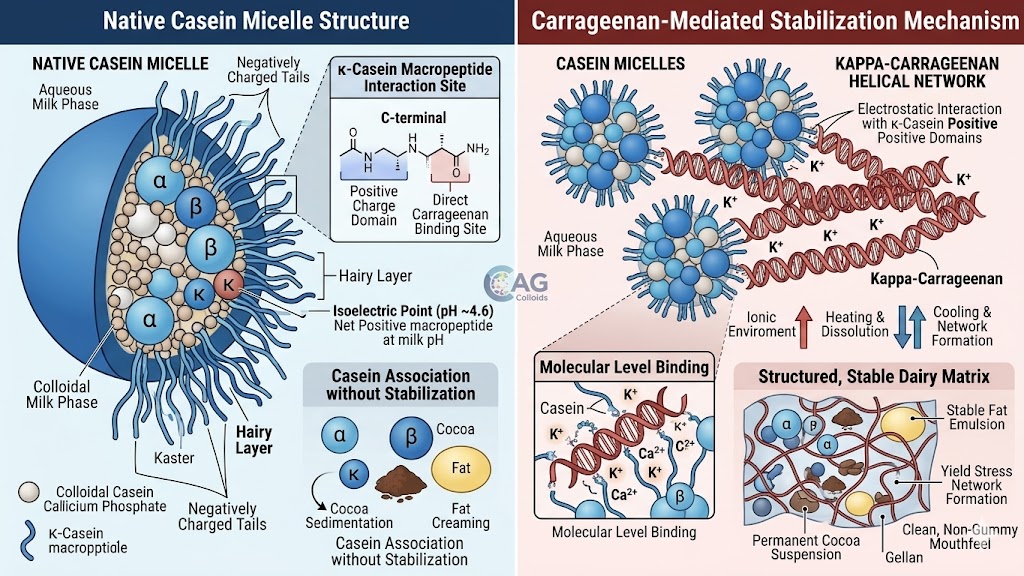
The mechanism centers on the structure of casein micelles in milk. Casein micelles are colloidal aggregates roughly 50–300 nm in diameter, with their outer surface coated predominantly by kappa-casein. This surface kappa-casein presents positively charged amino acid residues — lysine and arginine side chains — that are electrostatically complementary to the anionic sulfate ester groups distributed along the carrageenan backbone. When carrageenan is dispersed into milk and the system is heated above the gelling temperature, the carrageenan chains adsorb onto the casein micelle surface, forming a loosely cross-linked biopolymer network that spans the continuous serum phase.
In water gels, carrageenan must form its entire gel network through polysaccharide-polysaccharide junctions alone. In milk, the casein micelles serve as large, pre-formed junction zones that carrageenan bridges between — dramatically reducing the polymer concentration needed to establish a coherent network.
This network delivers three distinct functional outcomes in dairy processing. First, it prevents syneresis — the separation of liquid whey that occurs when casein micelles contract during storage or thermal treatment. Second, it suspends insoluble particles such as cocoa powder in chocolate milk, preventing sedimentation throughout shelf life. Third, it controls protein-protein aggregation during heat treatment, suppressing the fouling and burn-on that can occur when high-protein milk streams are processed at elevated temperatures.
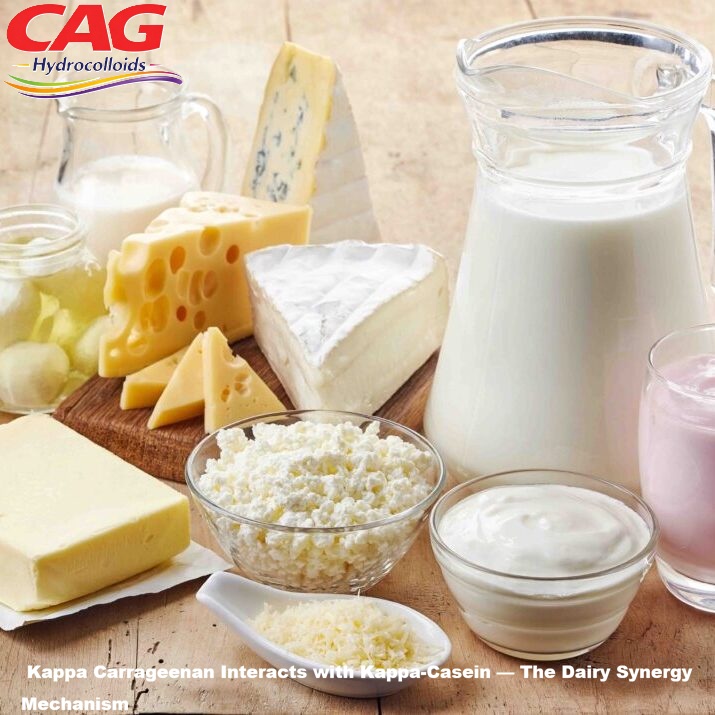
Fig. The interaction between kappa-carrageenan and kappa-casein is the most commercially significant protein-polysaccharide relationship in the food hydrocolloid industry
Kappa-2 carrageenan intensifies this effect further. Its additional C2-position sulfate groups increase the overall anionic charge density of the carrageenan chain, enhancing its affinity for the casein micelle surface. This is the primary reason why dairy-specific carrageenan blends — where κ2 content is deliberately elevated — achieve equivalent stability at even lower use levels, and why their gel strength is typically measured in milk rather than water to reflect the system in which they actually function.


Email: info@cagcolloids.com
Tel: 0086-19884908291 / 0086-573- 80890620
Website: www.cagcolloids.com
Address: No. 399, East Tongfu Road, Tongxiang City, Zhejiang Province. China.