


FAQs
Nature Refined, Quality Defined
Green Science for better living

How is the viscosity of xanthan gum measured?
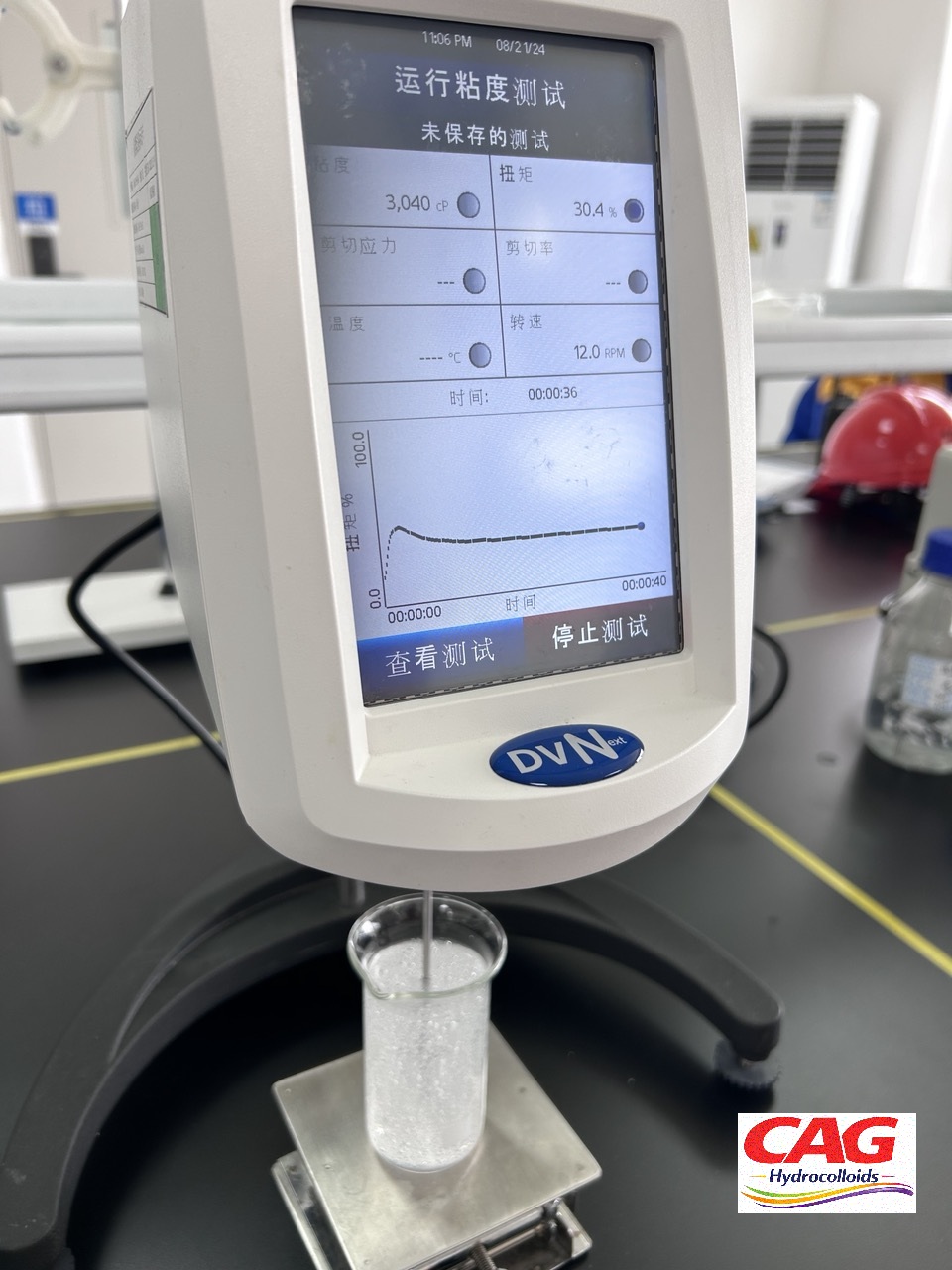
The viscosity of xanthan gum is typically measured using a rotational rheometer, most commonly a Brookfield viscometer. The core principle is to measure the resistance (torque) experienced by a specific spindle rotating in the sample at a defined speed and convert it into a viscosity value.
Standard Measurement Procedure:
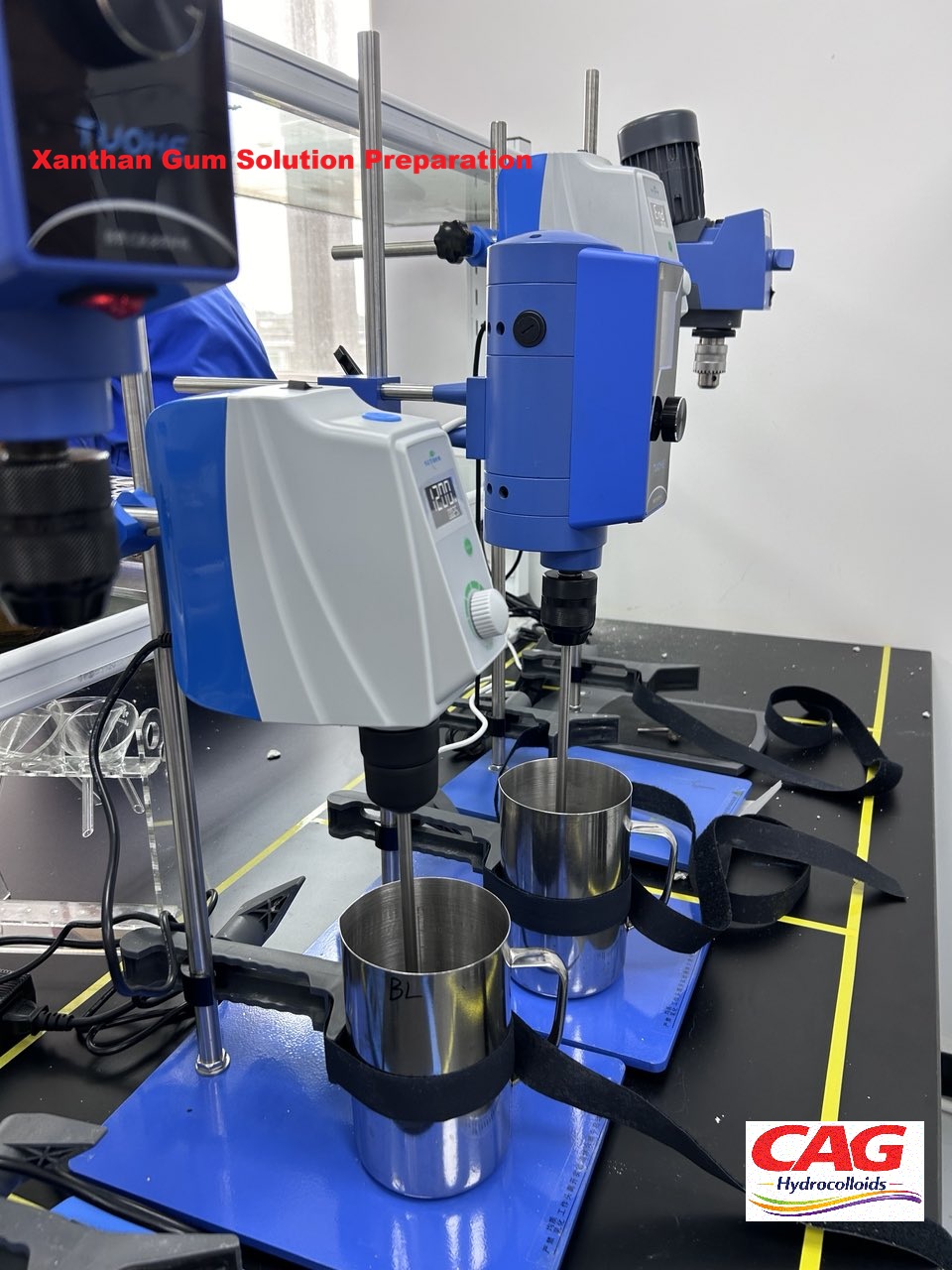
Solution Preparation (Most Critical Step):
Concentration: Usually 1.0% (w/v). Precisely weigh 1.000g (dry basis) of xanthan gum sample.
Solvent: Use deionized water or a salt solution of a specific ionic strength.
Dispersion and Dissolution:
Key Point: It is essential to ensure the sample is completely dissolved and free of "fish eyes". It is recommended to slowly sprinkle the xanthan gum powder into the water under high-speed stirring (>800 rpm) to utilize shear force for thorough dispersion.
Hydration: After dispersion, continue stirring for at least 2 hours, or let it stand overnight, to ensure complete hydration. Gentle heating (e.g., <50°C) can accelerate hydration, but avoid prolonged heating at high temperatures to prevent degradation.
Instrument and Parameter Setup:
Instrument: Brookfield viscometer (e.g., Brookfield type) or a more advanced temperature-controlled rheometer.
Spindle Selection: Choose an appropriate spindle model (e.g., a small LV series spindle) based on the estimated viscosity. Ensure the torque reading during measurement is between 10%-100% of the instrument's range, ideally 20%-80%.
Temperature Control: It is mandatory to use a water bath or Peltier temperature control system to precisely maintain the sample cup and spindle at the specified temperature. 25°C is the internationally accepted reporting temperature.
Speed Setting: This is a core variable. The rotational speed at which viscosity is measured must be clearly reported. A commonly reported speed is 60 rpm.
Measurement Process:
Transfer the prepared solution to the measurement cup, avoiding air bubbles.
Immerse the selected spindle into the solution to the specified mark.
Start the instrument and allow temperature equilibration at the set temperature for at least 5 minutes.
Set the speed, wait for the reading to stabilize (typically 30-60 seconds), and record the viscosity value (in mPa·s or cP, where 1 mPa·s = 1 cP).
Result Reporting:
Must report concentration, temperature, rotational speed, spindle model, and viscosity value. Example: "Viscosity of 1% aqueous solution at 25°C, 60 rpm, LV3 spindle is 1500 mPa·s".
This is a "typical value" range. The specific value is significantly influenced by:
Xanthan Gum Quality: Strain, fermentation process, post-processing (e.g., alcohol precipitation typically yields higher viscosity than direct drying).
Ionic Environment of Solution: Small amounts of salt (especially monovalent cations) significantly reduce its viscosity, while divalent cations (e.g., Ca²⁺) can increase viscosity at low concentrations and may induce gelation at high concentrations.
pH Value: Xanthan gum viscosity is stable in the pH range of 3-11.
Typical Range Reference:
|
Measurement Condition |
Typical Viscosity Range |
Notes |
|---|---|---|
|
1% Aq. Solution, 25°C, 60 rpm |
1200 - 2000 mPa·s |
This is the most commonly reported specification range for food-grade xanthan gum. High-quality products are typically > 1500 mPa·s. |
|
1% Aq. Solution, 25°C, 3 rpm (or very low speed) |
> 4000 mPa·s (can be as high as tens of thousands) |
Simulates quiescent or extremely low shear conditions, reflecting its high "zero-shear viscosity". |
|
Viscosity Ratio at 6 rpm and 60 rpm for 1% Aq. Solution, 25°C |
> 3.5 |
This is a common industry indicator used to characterize its shear-thinning capability (see Part III). |
Note: In industrial customer technical data sheets, a minimum viscosity value is usually explicitly guaranteed (e.g., Viscosity of 1% solution at 25°C, 60 rpm ≥ 1400 mPa·s).
Shear-thinning is one of the most significant and valuable rheological properties of xanthan gum. It is primarily characterized in two ways:
1. Apparent Viscosity Ratio Method (Most Common, Most Intuitive)
Method: Measure the viscosity of the same sample at two specific speeds, one low and one high, and calculate their ratio.
Common Indicators:
6 rpm / 60 rpm Viscosity Ratio: This is the most universal indicator in the xanthan gum industry. For high-quality xanthan gum, this ratio is typically greater than 3.5, and can reach 5-6. A higher ratio indicates stronger shear-thinning characteristics.
Calculation Formula: Shear-Thinning Index ≈ Viscosity(6 rpm) / Viscosity(60 rpm)
Physical Meaning: This ratio intuitively reflects the extent of viscosity reduction as the solution transitions from a "static/low-speed" state to "medium/high-speed" stirring or pumping. A larger ratio means the product feels thick in the mouth (low shear) but is easy to pump, mix, and pour (high shear).
2. Flow Curve Method (More Scientific, More Comprehensive)
Method: Use an advanced rheometer to perform a continuous shear rate sweep over a defined range (e.g., from 0.1 1/s to 100 1/s), obtaining a complete "viscosity vs. shear rate" flow curve.
Characterization Parameters:
Zero-Shear Viscosity: The plateau viscosity value of the curve as shear rate approaches zero. Represents the "thickness" of the fluid in a completely static state.
Infinite-Shear Viscosity: The plateau viscosity value of the curve at very high shear rates.
Flow Index (n): Fit the linear region of the middle part of the curve using the Power Law model (η = K * γⁿ⁻¹). Here, n is the flow index. For shear-thinning fluids, n < 1. A smaller n value indicates stronger shear-thinning behavior. The n value for xanthan gum typically ranges from 0.2 to 0.4.
Application Value: This method comprehensively describes the product's rheological behavior throughout the entire processing and application spectrum (from storage and pumping to spraying and swallowing). It is core data for high-end applications and R&D.
Summary:
Viscosity measurement requires strict standardization of conditions to ensure comparability of results.
The viscosity of a 1% solution at 60 rpm is a strength indicator, defining the baseline of its thickening capability.
The Shear-Thinning Index (6rpm/60rpm viscosity ratio) is a behavioral characteristic indicator, determining its unique convenience in processing and application. These two parameters together define the performance of xanthan gum and are key data that must be considered when selecting and using it.


Email: info@cagcolloids.com
Tel: 0086-19884908291 / 0086-573- 80890620
Website: www.cagcolloids.com
Address: No. 399, East Tongfu Road, Tongxiang City, Zhejiang Province. China.