

FAQs
Nature Refined, Quality Defined
Green Science for better living

How is food-grade agar used as a structuring agent in plant-based meat and vegan cheese
Plant-based food is one of the fastest-growing application segments for food-grade agar. However, the complexity of these matrices — proteins, fats and fibres coexisting — makes process control considerably more demanding than in jelly-type products.
Plant-based meat structuring: Agar functions as a "thermal setting" agent in meat analogues. In the sol state, it is mixed with texturised plant protein (TVP/TPC) and poured into moulds; on cooling the agar gel fills the interstitial spaces of the protein fibres, imparting sliceability and chew. Critical control points:
① Sol temperature must reach ≥90°C: Protein-based matrices have high viscosity. If agar is blended in before complete dissolution, undissolved particles create white specks on cut surfaces and localised strength inconsistencies. Dissolve agar fully in water before blending with the protein slurry.
② Fat interference with the gel network: When formulations contain saturated fats (e.g., coconut oil >10%), fat droplets compete for network space, reducing water-holding capacity and causing fat separation. Solutions: add an emulsifier (e.g., soy lecithin at 0.2–0.5%), or increase agar dosage to 1.5–2.0%.
③ Cooling rate control: Rapid cooling (e.g., ice-water bath) produces a fine, uniform gel network with clean slicing; slow cooling yields a coarser network prone to syneresis. In factory production, a tunnel-cooling conveyor that brings the product core temperature below 10°C within 30 minutes is recommended.
Vegan cheese: Typical formulations use agar at 1.5–2.5% (for firmness), coconut oil (for mouthfeel), and nutritional yeast (for flavour). The most common failure modes are too low an agar level — causing crumbling when sliced — or too high a level — causing a sandy or grainy texture. A small-scale matrix experiment starting at 1.8% is the recommended starting point for optimisation.
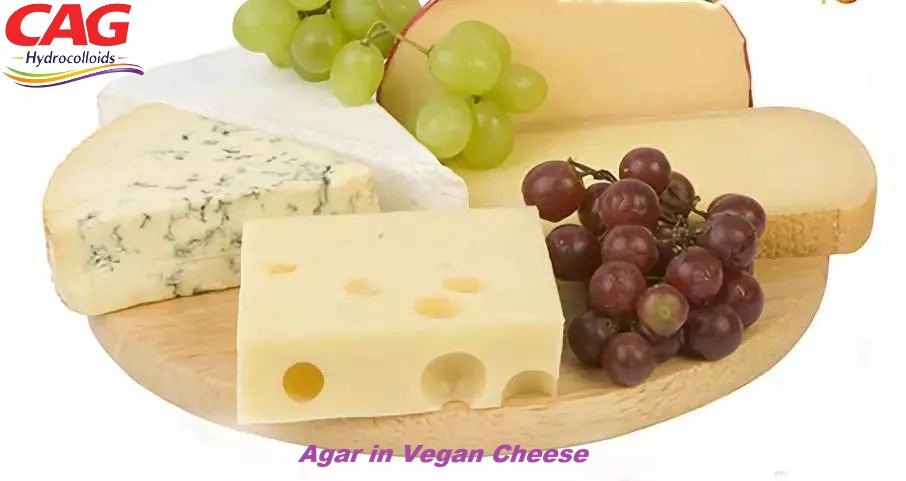
Fig. Agar agar for vegan cheese
Unlike starch-based gelling agents, agar in vegan cheese does not suffer severe freeze-thaw syneresis, making it the preferred structural agent for frozen-distribution plant-based cheese products.


Email: info@cagcolloids.com
Tel: 0086-19884908291 / 0086-573- 80890620
Website: www.cagcolloids.com
Address: No. 399, East Tongfu Road, Tongxiang City, Zhejiang Province. China.