


FAQs
Nature Refined, Quality Defined
Green Science for better living

How does kappa-carrageenan interact with milk proteins (casein) to stabilize chocolate milk and dairy systems?
Kappa-carrageenan exhibits a highly specific electrostatic interaction with kappa-casein in milk. At temperatures above the milk protein's isoelectric point, kappa-casein carries a localized net positive charge on its macropeptide tail (residues 113–169). The negatively charged ester sulfate groups of the kappa-carrageenan bind directly to these positive sites on the casein micelles. At very low concentrations (0.02%–0.03%), this interaction forms a weak, thixotropic milk-gel network capable of permanently suspending heavy cocoa particles or milk solids without increasing the liquid's apparent viscosity during drinking.
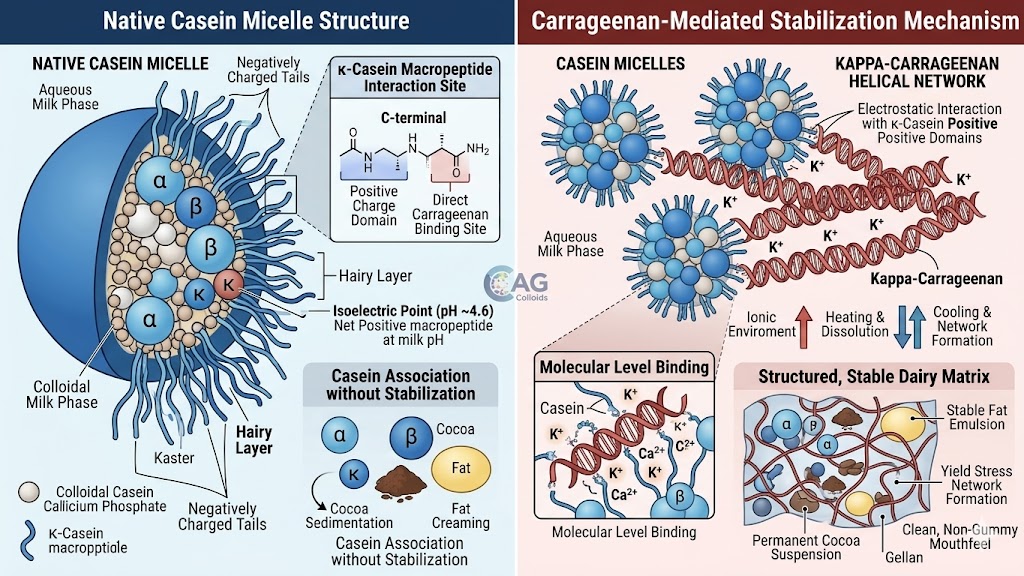
Figure: How the kappa-carrageenan helical network electrostatically binds with positive domains of casein micelles to create a stable, non-sedimenting dairy matrix.


Email: info@cagcolloids.com
Tel: 0086-19884908291 / 0086-573- 80890620
Website: www.cagcolloids.com
Address: No. 399, East Tongfu Road, Tongxiang City, Zhejiang Province. China.