

FAQs
Nature Refined, Quality Defined
Green Science for better living

How does Gellan Gum perform during freeze-thaw cycles in different matrices, and what are the improvement strategies?
Q: How does Gellan Gum perform during freeze-thaw cycles in different matrices, and what are the improvement strategies?
A:
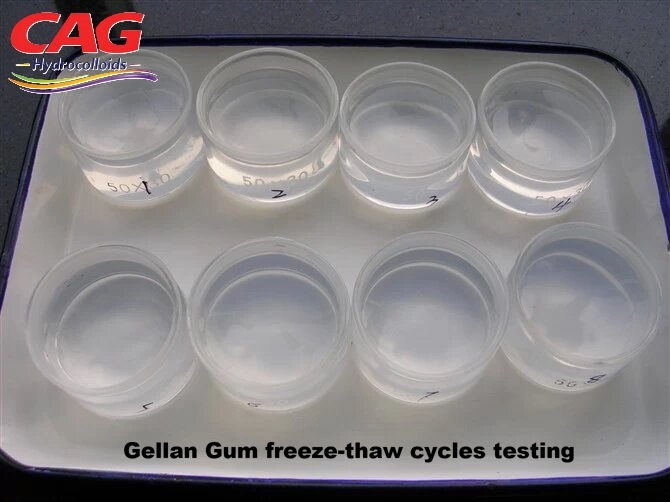
1. Universal Texture Damage Across All Applications
Regardless of the substrate, the core destructive mechanism of freeze-thaw cycling on Gellan Gum is consistent, though the manifestations vary:
Syneresis (Exudation/Weeping):
Generality: Occurs in almost all aqueous Gellan systems. Ice crystal growth during freezing squeezes the network, and upon thawing, the water cannot be reabsorbed.
Manifestation Differences:
In water-based gels (e.g., desserts, puddings), it appears as surface water leakage and collapse.
In suspensions (e.g., beverages, air freshener gels), it appears as supernatant separation and particle sedimentation/clumping.
Network Brittleness and Rupture:
Low-Acyl (LA): Already brittle in texture, it is highly prone to cracking and fragmentation after freeze-thaw, losing structural integrity.
High-Acyl (HA): Although elastic, extreme freezing can damage its flexible long-chain structure, leading to a loss of elasticity and resulting in a stiff or "spongy" texture with visible holes.
2. Specific Risks and Improvement Strategies by Application Category
A. Water-Based Gels (e.g., Desserts, Puddings, Jellies)
Risk Level: High.
Primary Issues: Severe syneresis and gel fracturing.
Improvement Strategies:
Sugar Alcohols/Polyols: Add Glycerol or Sorbitol (0.5%–2%) to lower the freezing point and inhibit ice crystal growth.
Composite Gums: Use HA + Locust Bean Gum (LBG) or HA + Xanthan Gum to construct a more flexible, entangled network resistant to ice crystal puncture.
Water Content Control: Appropriately reduce total water content to make the network denser and improve freeze resistance.
B. Air Freshener/Aroma Gels
Risk Level: Medium‑High (mostly HA-based, requiring long-term stability).
Primary Issues: Surface cracking, overall shrinkage, and premature aroma release.
Improvement Strategies:
Ethanol Management: Ethanol acts as both a solvent and an antifreeze; concentrations of 5%–15% significantly lower the freezing point, though excessive amounts may weaken the gel.
Film-Forming Agents: Trace additions of Polyvinylpyrrolidone (PVP) or MCC form a flexible film on the gel surface to prevent crazing.
pH Buffering: Maintain pH around 5–6 to prevent acidic essential oils from hydrolyzing the gel network.
C. Meat/Pet Food Gels
Risk Level: Medium (usually thermally processed and not frozen afterward).
Primary Issues: If frozen storage is required, a "spongy" structure can develop.
Improvement Strategies:
Protein Synergy: Gellan interacts with meat proteins (myofibrillar proteins) to form a composite network, enhancing toughness.
Phosphates: Sodium pyrophosphate can chelate metal ions and regulate Ca²⁺ activity to prevent excessive gel brittleness.
D. Plant-Based/Vegan Products
Risk Level: High (lacks the protective effect of milk proteins).
Primary Issues: Coarse texture and easy fracturing.
Improvement Strategies:
Starch Complexes: Use acetylated distarch phosphate or other freeze-stable starches to act as "physical springs."
Fiber Fillers: Microcrystalline Cellulose (MCC) or oat fiber provides a physical support skeleton.
3. Universal "Anti-Freezing" Formulation Logic (Cross-Category Applicability)
Regardless of the application, if freeze-thaw stability is required, the formulation design should follow these principles:
|
Strategy |
Common Additives |
Mechanism of Action |
|---|---|---|
|
Lower Freezing Point |
Glycerol, Sorbitol, Ethanol |
Lowers freezing temperature, reducing ice crystal size. |
|
Enhance Network Toughness |
MCC, Locust Bean Gum, Xanthan Gum |
Forms entanglements or physical skeletons to prevent crack propagation. |
|
Inhibit Recrystallization |
Sucrose, Trehalose |
Competes for water molecules, slowing ice crystal growth. |
|
Fine-tune Cross-linking |
Sodium Citrate, Sodium Pyrophosphate |
Chelates excess Ca²⁺ to prevent gel brittleness. |
Summary
Across all product categories, High-Acyl (HA) Gellan generally exhibits superior freeze-thaw stability compared to Low-Acyl (LA) Gellan. If a product must undergo freeze-thaw cycles, the most robust solution is:
HA Gellan Gum + Polyol (Glycerol/Sorbitol) + Microcrystalline Cellulose (MCC) or Xanthan Gum


Email: info@cagcolloids.com
Tel: 0086-19884908291 / 0086-573- 80890620
Website: www.cagcolloids.com
Address: No. 399, East Tongfu Road, Tongxiang City, Zhejiang Province. China.