


FAQs
Nature Refined, Quality Defined
Green Science for better living

How Does Carrageenan Improve Water Retention and Texture in Injected Meat Products? What Unique Advantages Does Semi-Refined Carrageenan (E407a) Offer Compared with Refined Carrageenan (E407)?
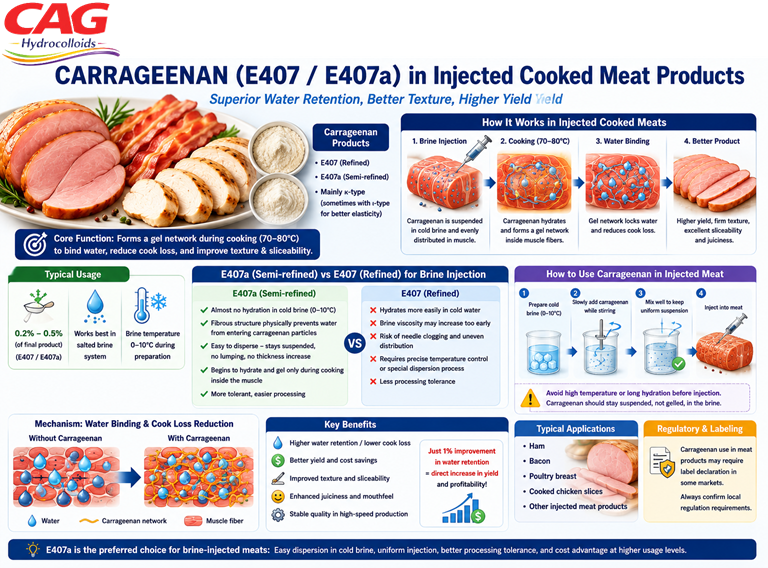
Injected meat products such as ham, bacon, chicken breast, and poultry slices are one of the most important application areas for carrageenan.
Unlike dairy applications, carrageenan does not work primarily through protein interaction. Instead, it improves product quality by forming a water-binding gel network during cooking.
0.2–0.5% of final product weight
Commonly used:
During brine injection, carrageenan should remain dispersed in the brine.
Premature hydration can cause:
Semi-refined carrageenan (E407a) hydrates very slowly in cold brine (0–10°C).
This allows it to:
E407a is generally more economical than refined carrageenan (E407).
Even a small improvement in water retention can significantly increase production yield and profitability.
Dairy applications = Protein interaction
Injected meat applications = Water-binding gel formation
The delayed hydration behavior of E407a makes it the preferred carrageenan type for many industrial meat products, including ham, bacon, poultry products, and cooked meat slices.
#Carrageenan #E407a #ProcessedMeat #FoodIngredients #Hydrocolloids #MeatProcessing


Email: info@cagcolloids.com
Tel: 0086-19884908291 / 0086-573- 80890620
Website: www.cagcolloids.com
Address: No. 399, East Tongfu Road, Tongxiang City, Zhejiang Province. China.