


FAQs
Nature Refined, Quality Defined
Green Science for better living

How do the chemical structural differences between KappaII and standard Kappa carrageenan
KappaII (κ-II) carrageenan is a naturally occurring carrageenan component found in certain red algae species (e.g., mixed Chondrus crispus populations). Its chemical signature is the retention of an additional sulphate substituent at the C-2 position on certain galactose units (i.e., 2,6-disulphated sites) on the κ-carrageenan backbone, giving it a total sulphate content between that of κ and ι — approximately 27–30%, compared to ~22–25% for standard κ.
This structural distinction produces two key performance shifts:
① Higher elasticity, lower brittleness. The additional sulphate groups introduce more inter-chain repulsion during double-helix aggregation, inhibiting excessive bundling and producing shorter, more dispersed junction zones. This network architecture shifts the gel from "hard-brittle" toward "tough-elastic": at the same concentration, κ-II gels show approximately 20–35% higher failure strain than standard κ — meaning they withstand greater deformation before fracturing.
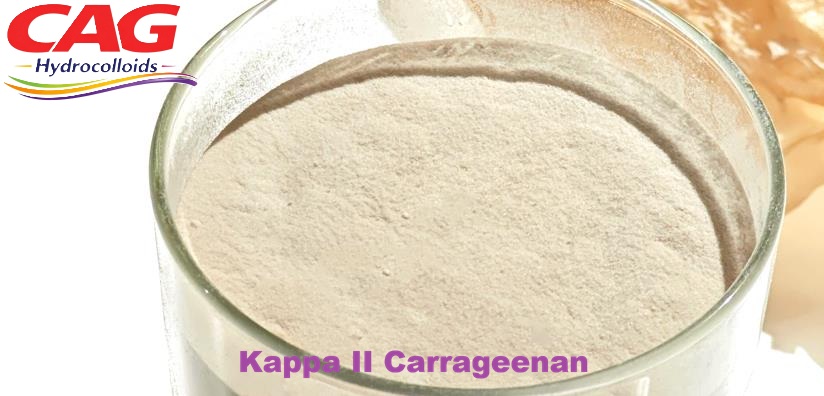
Fig. Kappa II Carrageenan Powder
② Markedly improved freeze-thaw stability. Standard κ-carrageenan gels lose substantial water after freeze-thaw cycling because ice crystal growth disrupts the dense network; κ-II's dispersed junction-zone architecture resists ice crystal damage far better, reducing freeze-thaw syneresis by 40–60% compared to standard κ.
In processed meat applications (injected ham, restructured meat, chicken breast products), these two properties translate directly into: (i) a tough gel that forms within muscle fibre interstices during cooking, locking in injected water (water-holding improvement of 8–15% vs. standard κ); and (ii) frozen sliced products that display a clean cross-section with no exudate after thawing — a substantially higher commercial value.
CAG Hydrocolloids KappaII carrageenan has traceable seaweed species provenance and reports a sulphate content range of 27–30% on each COA. Purchasers are advised to treat this as a key acceptance criterion, helping to distinguish genuine κ-II from standard κ-carrageenan incorrectly labelled as "KII" — a known issue in the market.


Email: info@cagcolloids.com
Tel: 0086-19884908291 / 0086-573- 80890620
Website: www.cagcolloids.com
Address: No. 399, East Tongfu Road, Tongxiang City, Zhejiang Province. China.