


FAQs
Nature Refined, Quality Defined
Green Science for better living

How Do Ionic Strength and Specific Cation Types Affect Carrageenan Gel Strength? Why Is Potassium Much More Effective Than Sodium for κ-Carrageenan?
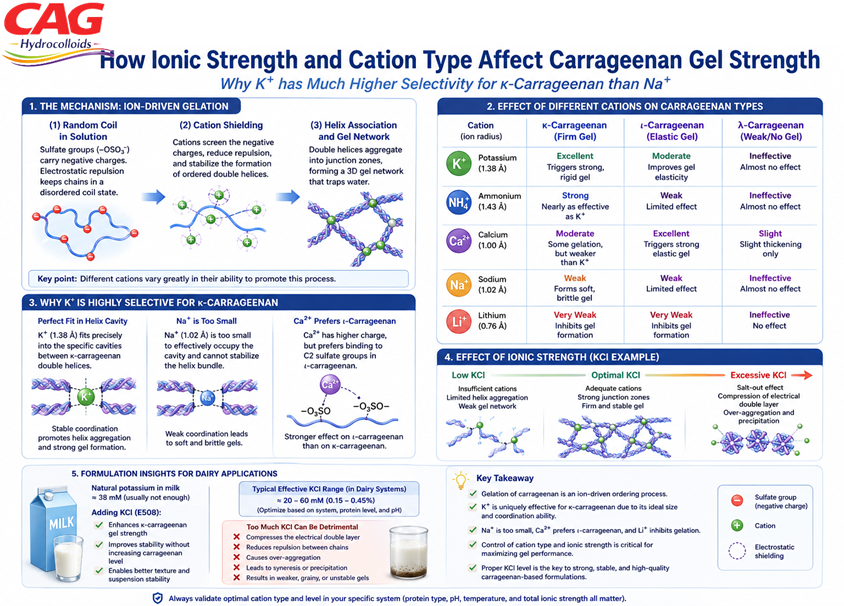
The gelation of carrageenan is fundamentally an ion-driven ordering process, and different cations vary dramatically in their ability to promote this process. Understanding these differences is essential for explaining why potassium chloride levels must be carefully controlled in commercial stabilizer systems.
The sulfate ester groups on carrageenan molecules carry negative charges. In aqueous solution, electrostatic repulsion between these charges causes the polymer chains to remain in a disordered random coil conformation.
When cations are introduced, they shield the negative charges and reduce electrostatic repulsion between polymer chains. This makes the formation of ordered double-helix structures thermodynamically favorable. The key factor is that the effectiveness of charge shielding depends on how well the ion's size and charge density match the carrageenan molecular structure.
| Cation | Effect on κ-Carrageenan | Effect on ι-Carrageenan | Effect on λ-Carrageenan |
|---|---|---|---|
| K⁺ (Potassium) | Very strong – triggers firm, rigid gels | Moderate improvement | Almost no effect |
| NH₄⁺ (Ammonium) | Strong (close to K⁺) | Weak | Almost no effect |
| Ca²⁺ (Calcium) | Moderate | Strong – triggers elastic gels | Slight thickening |
| Na⁺ (Sodium) | Weak – produces soft and brittle gels | Weak | Almost no effect |
| Li⁺ (Lithium) | Very weak – may inhibit gelation | Very weak | No effect |
The remarkable effectiveness of potassium ions originates from their ideal ionic radius (1.38 Å).
K⁺ fits precisely into specific cavity sites located within bundles of κ-carrageenan double helices. This creates stable coordination interactions that strongly promote helix aggregation and the formation of a three-dimensional gel network.
By contrast:
As a result, the gel-promoting efficiency for κ-carrageenan generally follows:
K⁺ > NH₄⁺ > Ca²⁺ > Na⁺ > Li⁺
The concentration of cations is just as important as their type.
More is not always better.
Excessive K⁺ can compress the electrical double layer surrounding carrageenan molecules, leading to:
This mechanism explains why potassium chloride (E508) is often added separately in dairy stabilizer systems.
Milk naturally contains approximately 38 mM potassium, but this concentration is often insufficient to fully maximize the gel strength of κ-carrageenan.
By supplementing the system with an appropriate amount of K⁺:
However, potassium supplementation must be carefully optimized. Excessive KCl addition may lead to salting-out phenomena and excessive carrageenan aggregation, ultimately reducing stability rather than improving it.
Carrageenan gelation is not simply a matter of adding salts—it is a highly selective molecular recognition process.
For κ-carrageenan, potassium ions possess the ideal size and coordination characteristics to stabilize double-helix aggregation, making them far more effective than sodium ions. Proper control of both cation type and ionic strength is therefore one of the most powerful tools available to formulators seeking to optimize texture, gel strength, and stability in dairy and other carrageenan-based systems.

Email: info@cagcolloids.com
Tel: 0086-19884908291 / 0086-573- 80890620
Website: www.cagcolloids.com
Address: No. 399, East Tongfu Road, Tongxiang City, Zhejiang Province. China.