


FAQs
Nature Refined, Quality Defined
Green Science for better living

Global Regulatory Status of Gellan Gum: Labeling Differences Across Key Markets
A technical overview of the regulatory approval, ADI, and labeling requirements for Gellan Gum (E418) in the EU, USA, China, Japan, and the EAEU.
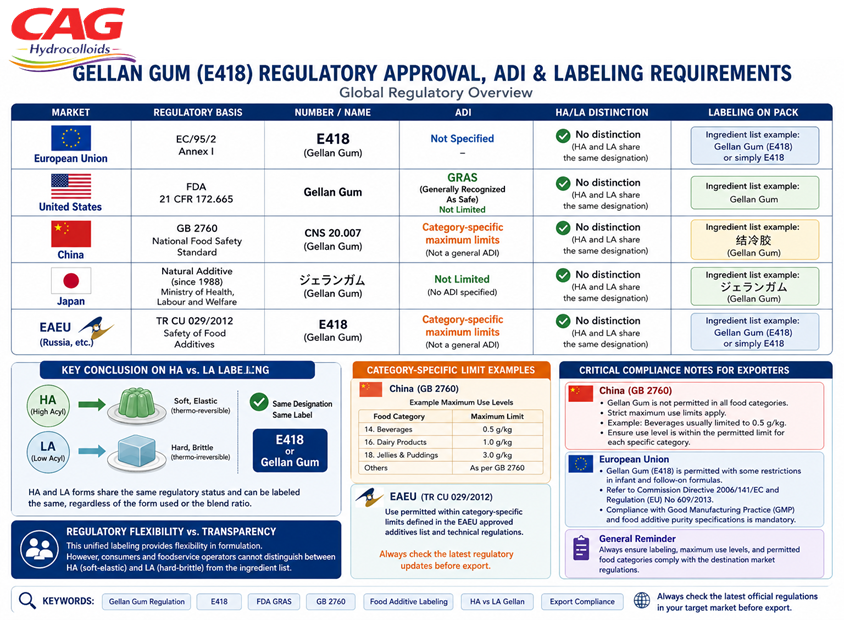
Gellan Gum is one of the most widely approved microbial polysaccharides globally. However, approval history and labeling requirements vary significantly by region. The following table summarizes the key differences:
| Market | Regulatory Basis | Number / Name | ADI | HA/LA Distinction |
|---|---|---|---|---|
| European Union | EC/95/2 Annex I | E418 | Not Specified | No distinction (Labeled as E418) |
| United States | FDA 21 CFR 172.665 | Gellan Gum | GRAS (Not Limited) | No distinction |
| China | GB 2760 | CNS 20.007 | Category-specific limits | No distinction |
| Japan | Natural Additive (since 1988) | ジェランガム (Gellan Gum) | Not Limited | No distinction |
| EAEU (Russia, etc.) | TR CU 029/2012 | E418 | Category-specific | No distinction |
The regulations explicitly state that High Acyl (HA) and Low Acyl (LA) forms share the same designation. Manufacturers are permitted to label products simply as "E418" or "Gellan Gum," regardless of whether HA, LA, or a blend is used.
Regulatory Flexibility vs. Transparency: This unified labeling provides significant flexibility in formulation design. However, it also means that consumers and foodservice operators cannot distinguish between the two functionally distinct forms (soft-elastic vs. hard-brittle) based on the ingredient list alone.
Keywords: Gellan Gum Regulation, E418, FDA GRAS, GB 2760, Food Additive Labeling, HA vs LA Gellan, Export Compliance.
Email: info@cagcolloids.com
Tel: 0086-19884908291 / 0086-573- 80890620
Website: www.cagcolloids.com
Address: No. 399, East Tongfu Road, Tongxiang City, Zhejiang Province. China.