


FAQs
Nature Refined, Quality Defined
Green Science for better living

Gellan Fluid Gels — Mechanism, Preparation, and Beverage Applications
Fluid gels occupy a sophisticated structural category: they are both gels and fluids. Gellan reliably produces fluid gels across wide pH and ionic conditions—unique among hydrocolloids.
Fluid gels appear contradictory: they flow like viscous liquids yet behave as structured solids at rest, possessing a measurable yield stress—the minimum force required to initiate flow. This yield stress makes fluid gels exceptional suspending agents: unlike traditional thickeners that merely slow particle sedimentation through viscosity, fluid gel networks physically support particles against gravity. Sensory results are profound—beverages stabilized with fluid gels feel watery in the mouth while perfectly suspending cocoa, pulp, or protein aggregates for months.
Fluid gels are prepared by applying mechanical shear during the cooling of a gellan solution through its setting temperature. Shear disrupts the forming macroscopic gel network, generating a population of uniformly dispersed microgel particles. At rest, these particles pack together and rebuild structure; when external force exceeds the yield stress, particles slide past each other and the system flows. Final viscosity correlates directly with the gel strength that would have formed without shear.
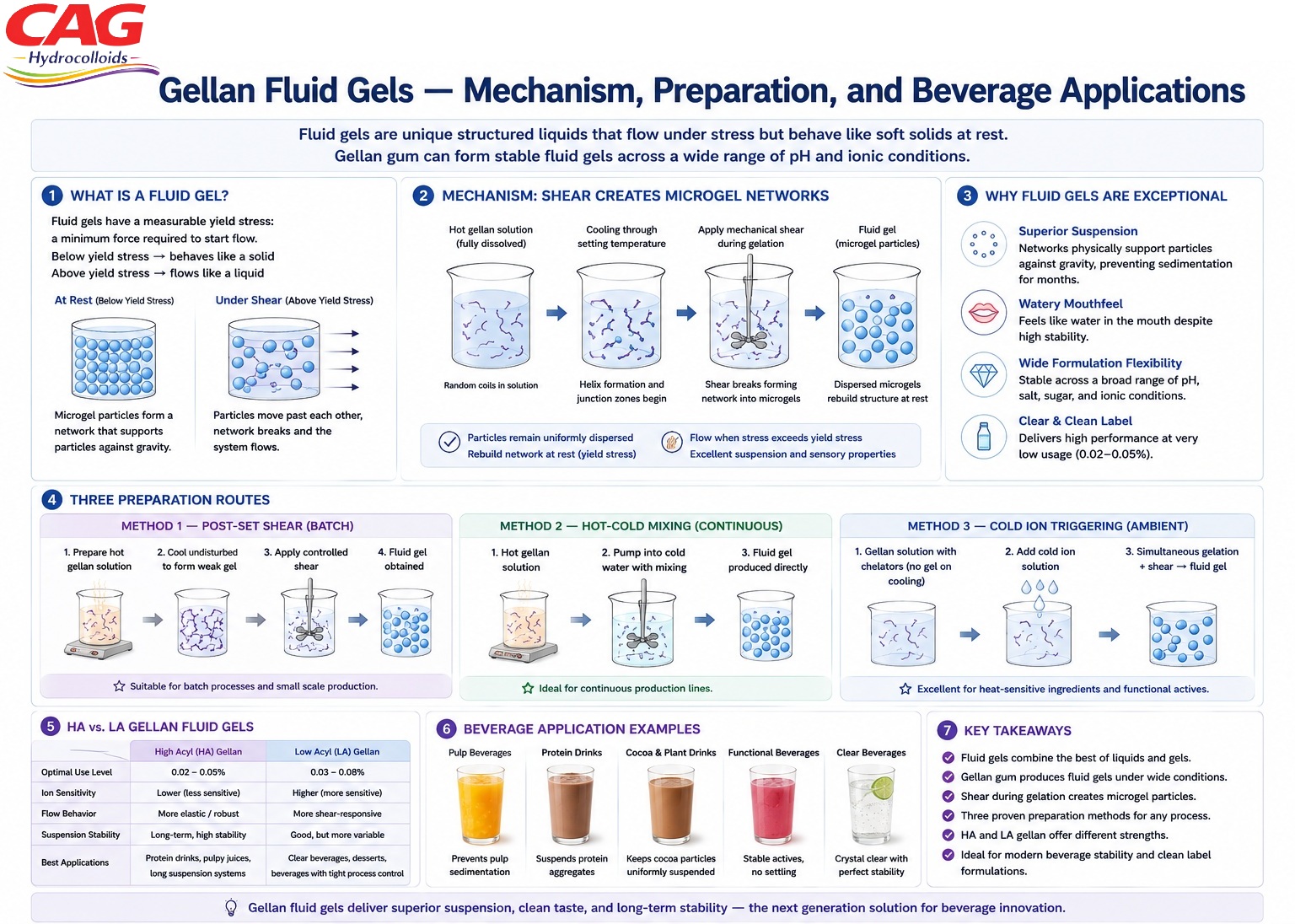
Method 1 — Post‑set shear: Allow a weak gel to form undisturbed, then apply controlled shear (stirring, homogenization, pumping) to break it into a fluid gel. Suitable for batch processes.
Method 2 — Hot‑cold mixing: Pump hot hydrated gellan solution into cold water under continuous mixing, producing fluid gel directly. Ideal for continuous processes.
Method 3 — Cold ion triggering: Prepare a solution that will not gel upon cooling (using chelators to suppress ionic gelation), then add a cold ion solution to the cold gellan sol—gelation and shear occur simultaneously at ambient temperature. Excellent for heat‑sensitive formulations.
HA gellan fluid gels (0.02–0.05%) are less ion‑sensitive, more elastic in flow behavior, and ideal for long‑suspension products. LA gellan fluid gels respond more sharply to shear but are more ion‑sensitive.

Email: info@cagcolloids.com
Tel: 0086-19884908291 / 0086-573- 80890620
Website: www.cagcolloids.com
Address: No. 399, East Tongfu Road, Tongxiang City, Zhejiang Province. China.