


FAQs
Nature Refined, Quality Defined
Green Science for better living

Formulation and Processing of Agar Crystal Balls with Agar-Based Hydrocolloids
The core gelling agent in agar crystal balls is agar, often blended with other hydrocolloids to modify texture. The basic formulation framework is as follows:
|
Material Category |
Specific Ingredient |
Typical Dosage |
Function & Requirement |
|---|---|---|---|
|
Primary Gelling Agent |
Agar |
0.8% - 2.0% |
Core structural skeleton. Provides thermoreversible gelation, forming the solid matrix. Concentration determines hardness and brittleness. |
|
Texture Modifier |
0.1% - 0.5% |
Blended with agar to increase elasticity, improve brittle fracture behavior, and enhance gloss. Gellan gum significantly increases crispness and hardness. |
|
|
Plasticizer/Humectant |
Sugars, Sugar Alcohols |
10% - 30% |
Provides sweetness, lowers water activity, prevents gel aging/hardening and syneresis, maintaining a soft mouthfeel. |
|
Flavor & Color |
Fruit Juice, Jam, Flavor Syrup, Colorants |
As needed |
Imparts internal flavor and color. Can be uniformly distributed or used to create a filled center. |
|
Acidulant |
Citric Acid, Malic Acid |
0.2% - 0.8% |
Adjusts sourness. Critical: Must be added after agar is dissolved and the solution has cooled slightly. |
|
Water |
Potable/Purified Water |
Balance |
Solvent. |
Formulation Logic: This is a bulk gel system. The final product is a solid or soft-centered gel bead. The sensory experience comes from the moment the teeth rupture the gel wall, releasing any encapsulated liquid or softer gel inside.
Agar crystal balls are based on the thermoreversible gelation property of agar:
High-Temperature Dissolution: Agar is completely dissolved in boiling water to form a homogeneous solution.
Low-Temperature Gelation: When this solution cools below approximately 32-40°C, agar molecules form double helices and aggregate, creating a robust three-dimensional network.
Drop Formation: The hot agar solution is dripped or extruded into a cold oil bath. The droplets solidify almost instantly into spheres as they descend.
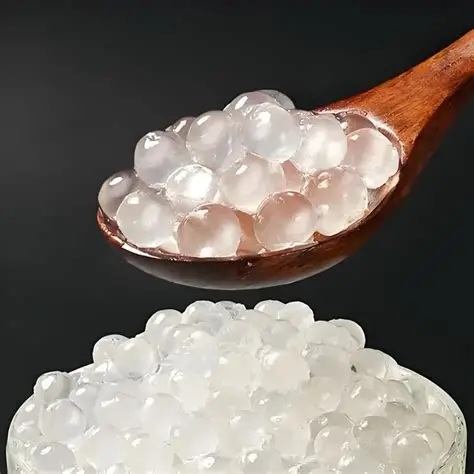
This is the most efficient method for producing highly spherical crystal balls.
1. Preparation of Agar Gel Solution
Dispersion: Dry-blend agar with sugar and other hydrocolloids. Disperse this blend evenly into cold water under agitation.
Heating & Hydration: Heat to 95-100°C and maintain for 5-10 minutes to ensure complete dissolution.
Flavoring & Acidification: Cool the solution to 70-80°C, then add acidulants, flavors, colors, etc., and mix rapidly.
Temperature Maintenance: Transfer the prepared solution to a holding tank, maintaining temperature at 60-70°C.
2. Cold-Oil Dripping Forming (Core Step)
Oil Bath Preparation: Use vegetable oil, pre-cooled to 5-15°C. Oil temperature is critical for sphericity and surface finish.
Dripping: The agar solution is passed through a multi-orifice dripping head or a vibrating droplet generator to form uniform droplets, which fall into the cold oil.
Gelation & Forming: Within seconds, the droplets cool below their gelation point and solidify into spheres.
3. Collection & Post-Processing
Screening & Collection: The gelled balls are separated from the oil using a sieve.
De-oiling & Washing: Rinse to remove the surface oil film.
Stabilization Treatment: Soak the balls in a sugar syrup or preservative solution.
|
Common Problem |
Potential Causes |
Expert Solutions |
|---|---|---|
|
Misshapen Spheres, Tailing |
1. Solution temperature too high. |
1. Control solution temperature to 60-65°C. |
|
Rough/Wrinkled Surface |
1. Gelation too rapid. |
1. Slightly increase oil temperature. |
|
Texture Too Hard, Not Crisp |
1. Agar concentration too high. |
1. Reduce agar dosage. |
|
Texture Too Soft, Easily Deformed |
1. Agar concentration insufficient. |
1. Increase agar concentration. |
|
Off-flavors or Rancid Taste |
1. Oil bath oxidation. |
1. Use stable oil; filter and replace regularly. |
Fundamental Difference: Agar crystal balls are a bulk thermal gel, distinct from ionic-gel-based "popping boba".
Innovation Potential:
Filled Core Technology: Create "shell-core" structures.
Composite Textures: Engineer mouthfeel via hydrocolloid blends.
Functionalization: Add value-added ingredients.
Process is Critical: Quality is largely determined by precise control of the forming process.


Email: info@cagcolloids.com
Tel: 0086-19884908291 / 0086-573- 80890620
Website: www.cagcolloids.com
Address: No. 399, East Tongfu Road, Tongxiang City, Zhejiang Province. China.