


FAQs
Nature Refined, Quality Defined
Green Science for better living

Electrostatic Compatibility of Gellan and Gelatin — Why Type B Gelatin Is Recommended
Combining gellan with gelatin unlocks useful textures and processing benefits—but the electrostatic relationship must be deliberately managed.
Gellan and gelatin are a productive combination in dessert jellies, meat aspics, and layered confections. Adding low levels of LA gellan to gelatin systems raises the initial setting temperature to ~35 °C—enabling faster production line handling—and increases the melting point, extending shape retention after removal from refrigeration. In dry‑mix dessert systems, accelerated initial set allows subsequent layers to be filled sooner. These benefits are real and commercially valuable.
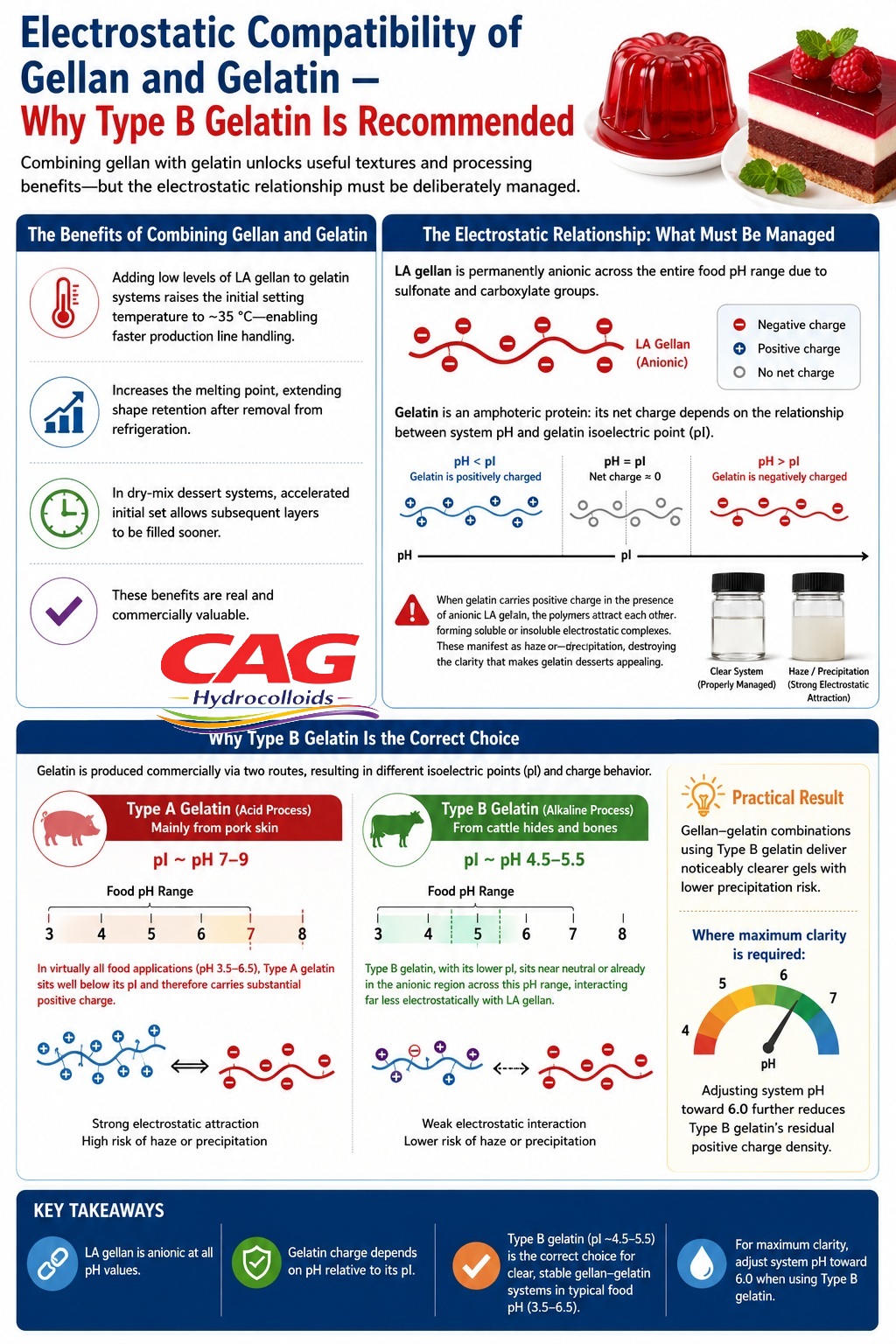
What must be designed around is the electrostatic relationship. LA gellan is permanently anionic across the entire food pH range due to sulfonate and carboxylate groups. Gelatin is an amphoteric protein: its net charge depends on the relationship between system pH and gelatin isoelectric point (pI). Below pI, gelatin carries net positive charge; above pI, negative charge. When gelatin carries positive charge in the presence of anionic LA gellan, the polymers attract each other, forming soluble or insoluble electrostatic complexes. These manifest as haze or—at higher concentrations—precipitation, destroying the clarity that makes gelatin desserts appealing.
Gelatin is produced commercially via two routes: acid treatment of collagen (Type A, mainly pork skin), yielding pI ~pH 7–9; and alkaline treatment (Type B, from cattle hides and bones), yielding pI ~pH 4.5–5.5. In virtually all food applications (pH 3.5–6.5), Type A gelatin sits well below its pI and therefore carries substantial positive charge. Type B gelatin, with its lower pI, sits near neutral or already in the anionic region across this pH range, interacting far less electrostatically with LA gellan. Practical result: gellan–gelatin combinations using Type B gelatin deliver noticeably clearer gels with lower precipitation risk. Where maximum clarity is required, adjusting system pH toward 6.0 further reduces Type B gelatin’s residual positive charge density.
gellan gelatin blend, LA gellan gelatin transparency, Type B gelatin gellan, gellan electrostatic interaction, gellan gelatin dessert jelly, gellan isoelectric point, gelatin replacement gellan

Email: info@cagcolloids.com
Tel: 0086-19884908291 / 0086-573- 80890620
Website: www.cagcolloids.com
Address: No. 399, East Tongfu Road, Tongxiang City, Zhejiang Province. China.