


FAQs
Nature Refined, Quality Defined
Green Science for better living

Different Seaweeds, Different Carrageenan Types
In the vast world of marine botany, not all seaweeds are created equal. The specific species of red algae determines its unique polysaccharide structure, which in turn dictates the type of carrageenan extracted and its functional properties.
We provide a clear overview of the primary botanical sources for industrial carrageenan production:
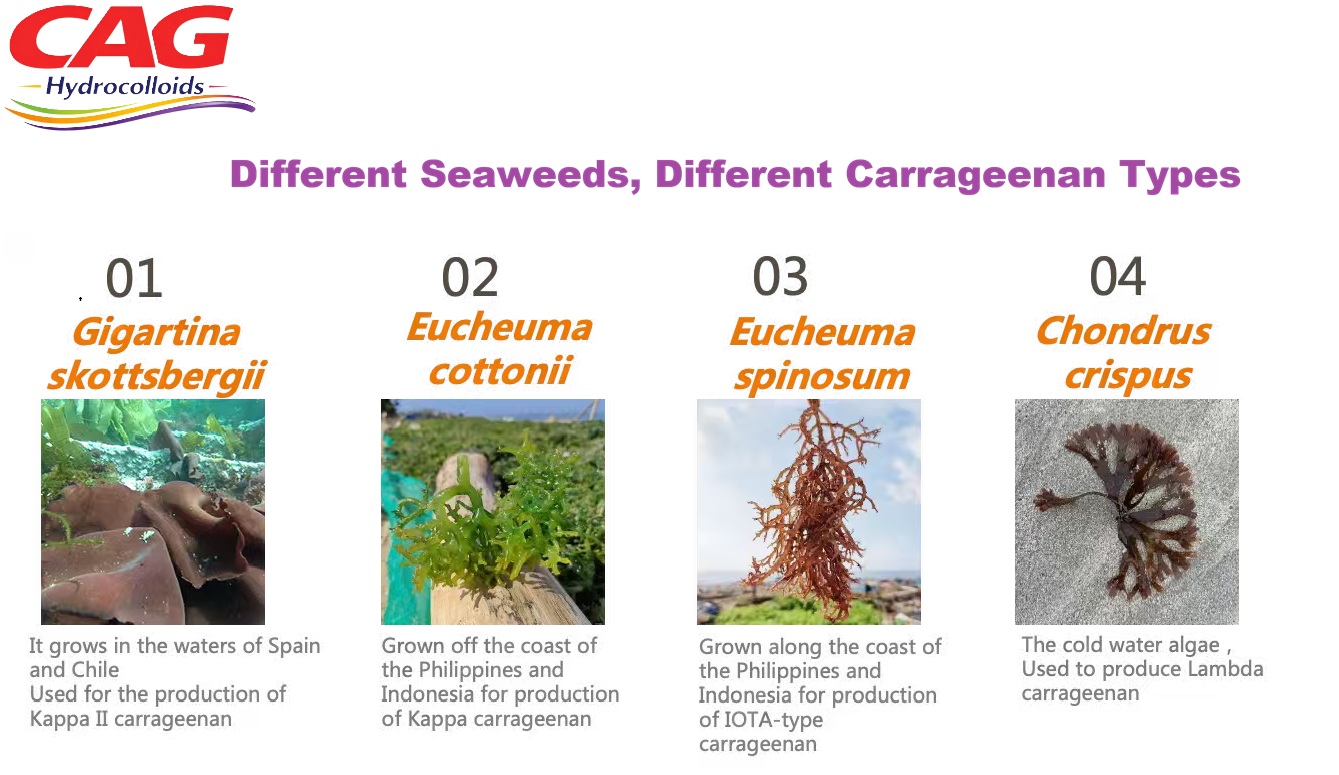
01 Gigartina skottsbergii(Giant Irish Moss)
Origin: Clean waters of Spain and Chile.
Output: Kappa-2 Carrageenan.
Properties: Characterized by high gel strength and brittleness. It is the preferred choice for applications requiring a firm texture, such as specialty meat products and structured gels.
02 Eucheuma cottonii(Cottonii / Kappaphycus)
Origin: Tropical waters of the Philippines and Indonesia.
Output: Kappa Carrageenan.
Properties: Forms strong, rigid, and brittle gels in the presence of potassium ions. Widely used in confectionery (gummies), dairy, and plant-based alternatives.
03 Eucheuma spinosum(Spinosum)
Origin: Tropical waters of the Philippines and Indonesia.
Output: Iota Carrageenan.
Properties: Creates soft, elastic, and cohesive gels when reacted with calcium ions. Ideal for applications requiring flexibility, such as processed meats, desserts, and dairy products.
04 Chondrus crispus(Irish Moss)
Origin: Cold Atlantic waters.
Output: Lambda Carrageenan.
Properties: Does not gel. It functions primarily as a thickener and stabilizer, providing viscosity and preventing syneresis (water leakage) in beverages and sauces.
Technical Summary:
The extraction source defines the molecular structure—Kappa provides rigidity, Iota provides elasticity, and Lambda provides viscosity. Selecting the right seaweed species is the first step in engineering the final texture of a product.


Email: info@cagcolloids.com
Tel: 0086-19884908291 / 0086-573- 80890620
Website: www.cagcolloids.com
Address: No. 399, East Tongfu Road, Tongxiang City, Zhejiang Province. China.