



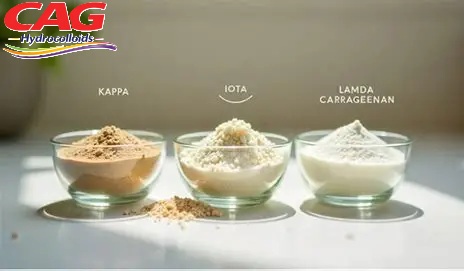
Carrageenan blending is not about averaging the properties of the component types — it is about generating emergent functionality that neither component exhibits alone. Each classic pairing has a specific structural rationale, and knowing that rationale allows formulators to extrapolate intelligently to new applications rather than relying on trial-and-error.
Kappa carrageenan + locust bean gum (LBG) is the most commercially important synergistic combination in the hydrocolloid industry. LBG's galactomannan chains carry unsubstituted mannose "smooth regions" that associate with the kappa carrageenan double-helix junction zones through hydrogen bonding, creating a co-network of dramatically higher strength and elasticity than either component achieves independently. Equally important, LBG incorporation suppresses syneresis — the free liquid that exudes from a pure kappa gel during storage. This combination is the standard of choice for dairy dessert gels requiring both firmness and shelf stability, and for cream cheese where elasticity and moisture retention are both required.
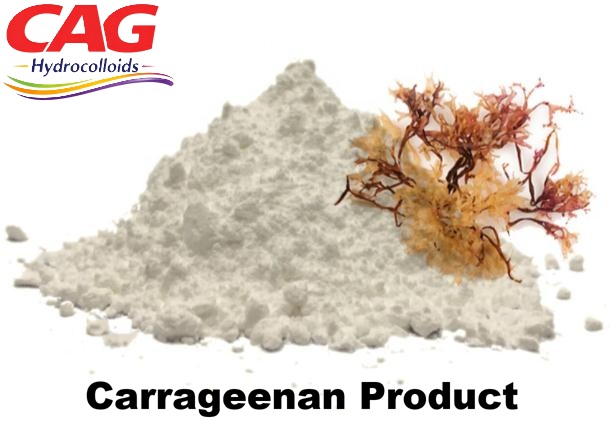
Kappa carrageenan + konjac glucomannan follows a similar synergy mechanism but delivers higher overall gel strength than the kappa-LBG system at equivalent concentrations. The konjac mannose backbone is longer and more flexible than LBG, providing more extensive junction-zone interaction. This combination is well-suited to applications requiring very firm gels with high water-holding capacity, including plant-based meat analogs and high-gel-strength confectionery.
Kappa + iota blending is the workhorse of texture tuning. Kappa provides the structural backbone and gel firmness; iota shifts the texture toward elasticity and reduces brittleness. Because both types are thermally reversible and both are gelation-active, their ratio can be adjusted continuously to move along the texture spectrum from firm-and-brittle to soft-and-bouncy. This is the standard approach for water dessert gels, where manufacturers maintain a family of products with different textures using different kappa-to-iota ratios rather than changing the overall system design.
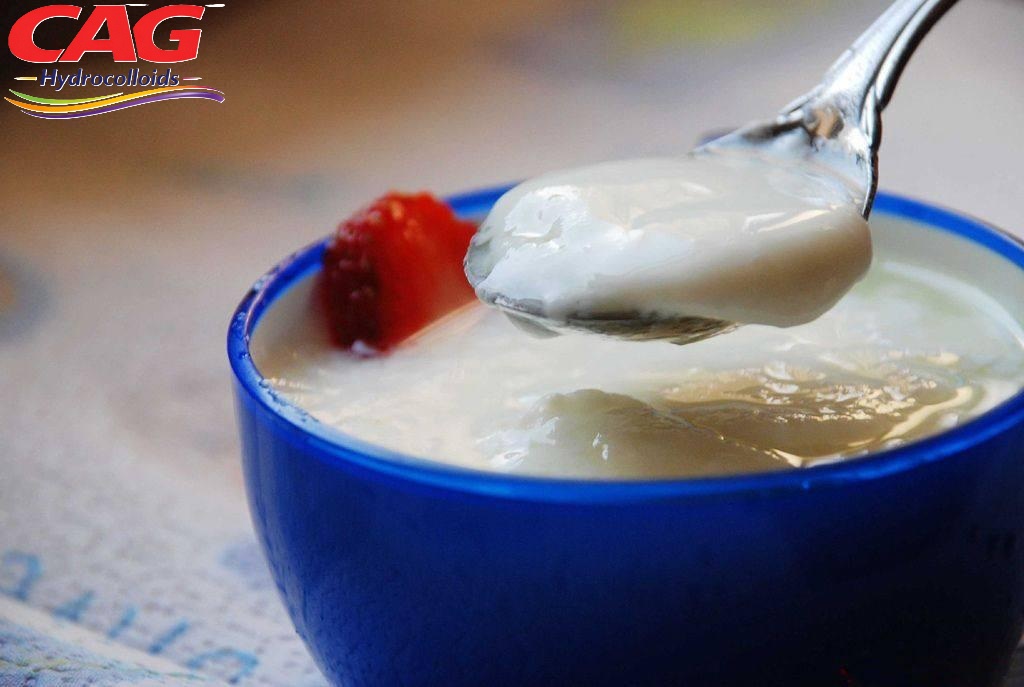
In milk systems, blending kappa or kappa-2 with lambda carrageenan is common for cold-prepared or shake-format products. Lambda does not gel, but its high sulfate content and cold solubility allow it to thicken and contribute mouthfeel immediately upon mixing, while kappa/kappa-2 provides the structural interaction with casein that ensures long-term suspension stability.
| Blend | Primary mechanism | Key benefit | Typical application |
|---|---|---|---|
| κ + LBG | Helix-mannan co-network | Strength + syneresis control | Dairy gels, cream cheese |
| κ + Konjac | Helix-glucomannan co-network | Very high gel strength | Plant-based meat, confectionery |
| κ + ι | Dual-helix network modulation | Texture spectrum control | Water dessert gels, puddings |
| κ/κ2 + λ | Gelation + cold thickening | Instant body + long-term stability | Milkshakes, cold-prepared desserts |
| κ/κ2 + LBG (acid systems) | Steric hindrance of protein binding | Controlled protein aggregation | Yogurt, acidified dairy |
The unifying design principle across all these combinations: identify which functional dimension the primary carrageenan type cannot adequately address alone — whether that is syneresis, brittleness, cold solubility, or protein over-association — and select the co-ingredient specifically to address that gap. Blending for its own sake adds cost without adding value.