

FAQs
Nature Refined, Quality Defined
Green Science for better living

Carrageenan in Processed Cheese — A Fundamentally Different Technical Logic
When most food technologists think of carrageenan in dairy, they think of stabilization at trace concentrations — 150 ppm in UHT milk, 0.02% in ice cream. Processed cheese operates in an entirely different regime. Carrageenan additions in cheese slices, blocks, and spreadable formats typically range from 0.3% to as high as 2.0%, placing it firmly in the structural-building category rather than the colloidal stabilization category. The functional logic is correspondingly different.
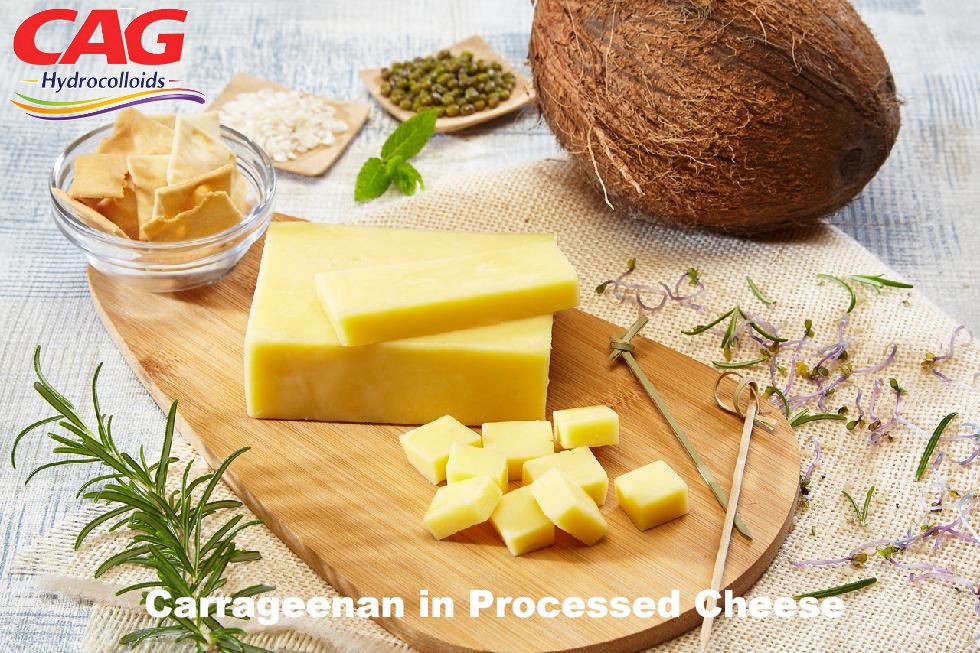
In processed cheese manufacture, the natural cheese curd is melted and emulsified with "melting salts" (phosphates and citrates) that solubilize the calcium-bridged casein network, allowing the proteins to re-emulsify the fat phase. Carrageenan — primarily kappa and kappa-2 types — is added to this melt to contribute three specific properties that the protein matrix alone cannot fully provide.
Melt behavior control: The carrageenan gel network sets around the protein-fat matrix as the product cools, reinforcing structure and adjusting how the cheese responds to reheating. By varying carrageenan type and concentration, manufacturers can tune melt characteristics from "stays firm when heated" (needed for grilling applications) to "flows readily" (needed for burger cheese slices).
Slicing and grating integrity: Carrageenan increases the firmness and cohesion of the cooled product, reducing crumbling during high-speed industrial slicing and preventing shredded pieces from clumping. This is directly related to carrageenan's ability to form a co-continuous network with the protein-fat matrix.
Partial cheese replacement: Within regulatory limits, the structural contribution of carrageenan allows manufacturers to partially substitute natural cheese content while maintaining acceptable texture and mouthfeel — a straightforward cost optimization in a commodity-sensitive category.
For cream cheese and spreadable formats, kappa carrageenan is typically blended with locust bean gum. The LBG synergy increases gel strength and elasticity while suppressing syneresis — critical for a product expected to be creamy and smooth after being spread at refrigerator temperatures.


Email: info@cagcolloids.com
Tel: 0086-19884908291 / 0086-573- 80890620
Website: www.cagcolloids.com
Address: No. 399, East Tongfu Road, Tongxiang City, Zhejiang Province. China.