

FAQs
Nature Refined, Quality Defined
Green Science for better living

Carrageenan and Low-Acyl Gellan Gum in Plant-Based Hollow Capsules: Mechanism and Formulation Guide
Hydroxypropyl methylcellulose (HPMC) is the backbone of every plant-based hard capsule — it's the film former that gives the shell its transparency, mechanical strength, and moisture barrier. But HPMC has one limitation: it does not gel on its own at ambient or moderately cool temperatures. Traditional gelatin capsules rely on gelatin's natural thermoreversible gelling behavior for dip-molding; HPMC needs a secondary gelling system to replicate that behavior on the production line.
This is where a carefully selected hydrocolloid pairing — kappa-carrageenan and low-acyl gellan gum — comes in.
Not all carrageenan types are created equal for this application. Carrageenan comes in several forms, but only kappa-carrageenan produces the sharp, thermoreversible, rigid gel that hard capsule production requires — activated specifically by potassium ions (K⁺). This combination is the industry-standard secondary gelling system used across commercial HPMC capsule shells.
Kappa-carrageenan's gel character matters as much as its gelling ability:
Low-acyl gellan gum is added as a synergistic co-gelling agent rather than a standalone gelling system. In blends with kappa-carrageenan, it reinforces the gel network, improves film homogeneity on the molding pins, and helps reduce syneresis (water weeping) in the finished shell.
One important formulation constraint: the cation source in this system must remain potassium-based, not calcium-based. While low-acyl gellan gum is generally more responsive to divalent cations like calcium, calcium-activated gellan gels are strongly thermally hysteretic — once set, they resist re-melting even at typical processing temperatures. In a continuous production environment where the gelling solution needs to stay flowable in tanks and piping, this creates real risk of premature gelling, line blockages, and product loss. Keeping the system potassium-only preserves the reversibility that makes continuous dip-molding possible, while still allowing the carrageenan–gellan pair to work synergistically at the gel network level.
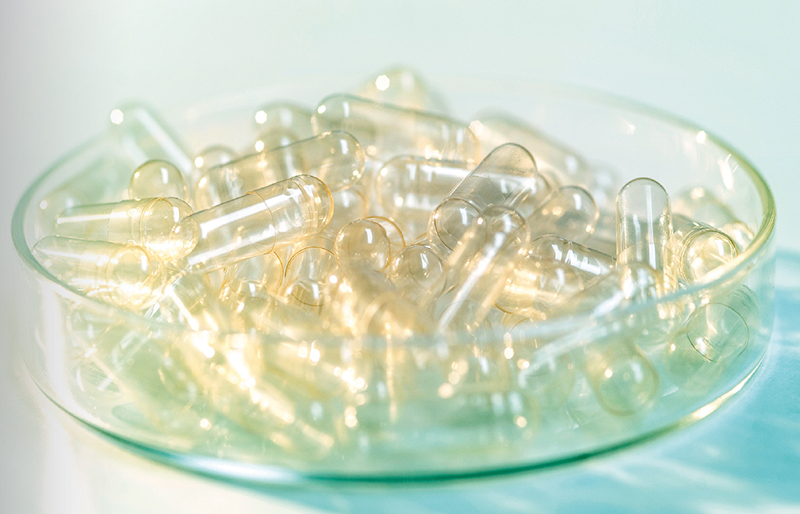
FIg. Plant based empty capsule made from Kappa carrageenan and Low acyl gellan gum
| Component | Typical Range | Function |
|---|---|---|
| HPMC (E5 grade, 2% viscosity 80–120 mPa·s) | 14%–17% | Primary film former |
| Kappa-carrageenan | ---- | Primary gel network |
| Low-acyl gellan gum | ---- | Synergistic gel reinforcement |
| K⁺ source (KCl or potassium citrate) | ---- | Gel network activator |
| Plasticizer (glycerin or triethyl citrate) | 0.3%–0.6% | Flexibility, crack resistance |
| Water | Balance (≈82%–85%) | Solvent |
Exact ratios should be fine-tuned against your target shell hardness, disintegration profile, and dip-molding line parameters. Small-scale trials are recommended before scale-up, particularly for the carrageenan-to-gellan ratio and K⁺ level.
Both kappa-carrageenan and low-acyl gellan gum are sensitive to raw material quality — viscosity consistency, gel strength, and clarity all vary meaningfully by supplier and production batch. For manufacturers scaling up plant-based capsule production, working with a supplier that can provide both hydrocolloids under one specification framework, along with formulation support for the carrageenan–gellan–K⁺ ratio, simplifies qualification and reduces batch-to-batch variability on the line.
Interested in a starting-point formulation or sample kit for your capsule production trials? Get in touch with our technical team.

Email: info@cagcolloids.com
Tel: 0086-19884908291 / 0086-573- 80890620
Website: www.cagcolloids.com
Address: No. 399, East Tongfu Road, Tongxiang City, Zhejiang Province. China.