


FAQs
Nature Refined, Quality Defined
Green Science for better living

Can Low-acyl Gellan Gum dissolve in cold water? If a chelating agent (such as sodium citrate) is added in advance to achieve complete dissolution in cold water, can this system form a gel directly in cold water?
Low-acyl Gellan Gum cannot dissolve directly in cold water; it can only form a uniform dispersion. This is because its molecular chains cannot fully hydrate at low temperatures. Complete dissolution to form a transparent solution requires heating to 75–90°C.
However, if a chelating agent (such as sodium citrate) is added to cold water beforehand, Low-acyl Gellan Gum can achieve hydration and dissolution in cold water.
Nevertheless, even after dissolution, it is generally not possible to form a gel with ideal strength directly in cold water. The reasons are as follows:
Lack of Cations: The gelling mechanism of Low-acyl Gellan Gum relies on the cross-linking effect of cations such as Ca²⁺ and Mg²⁺. Chelating agents (like sodium citrate) strongly bind these divalent cations present in the water.
System State: Although the gellan gum molecules are dissolved, the cations in the system are "locked" by the chelating agent. Due to the absence of free cations available for cross-linking, the formation of a gel network cannot be triggered.
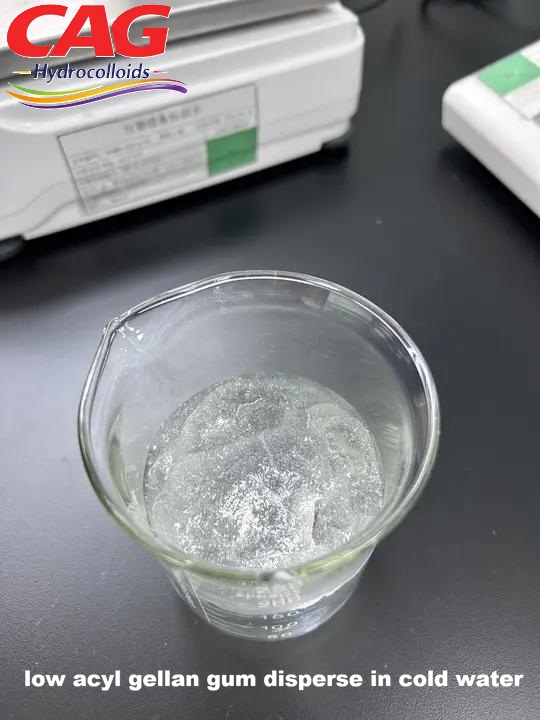
low acyl gellan gum can disperse in cold water
Conclusion: To induce gelation in this system, it is necessary to additionally supplement calcium or magnesium salts as cation sources after dissolution. Alternatively, adopting the traditional process of "dissolving by heating and then cooling" remains the standard method to obtain a firm gel.


Email: info@cagcolloids.com
Tel: 0086-19884908291 / 0086-573- 80890620
Website: www.cagcolloids.com
Address: No. 399, East Tongfu Road, Tongxiang City, Zhejiang Province. China.