


FAQs
Nature Refined, Quality Defined
Green Science for better living

Can Carrageenan Deliver the Same Stabilizing Effect in Plant-Based Milks (Oat, Soy, and Almond) as in Dairy Milk? What Are the Fundamental Differences in Formulation Logic?
The rapid growth of plant-based dairy alternatives has created a major challenge for carrageenan formulators. The exceptional performance of κ-carrageenan in dairy systems is primarily due to its specific interaction with κ-casein. This targeted interaction allows carrageenan to function effectively at extremely low usage levels in animal milk products.
However, plant proteins—including soy globulins, oat prolamins, and almond albumins—have fundamentally different surface charge distributions, isoelectric points, and structural organizations compared with casein micelles. As a result, carrageenan cannot rely on the same "targeted" stabilization mechanism in plant-based systems.
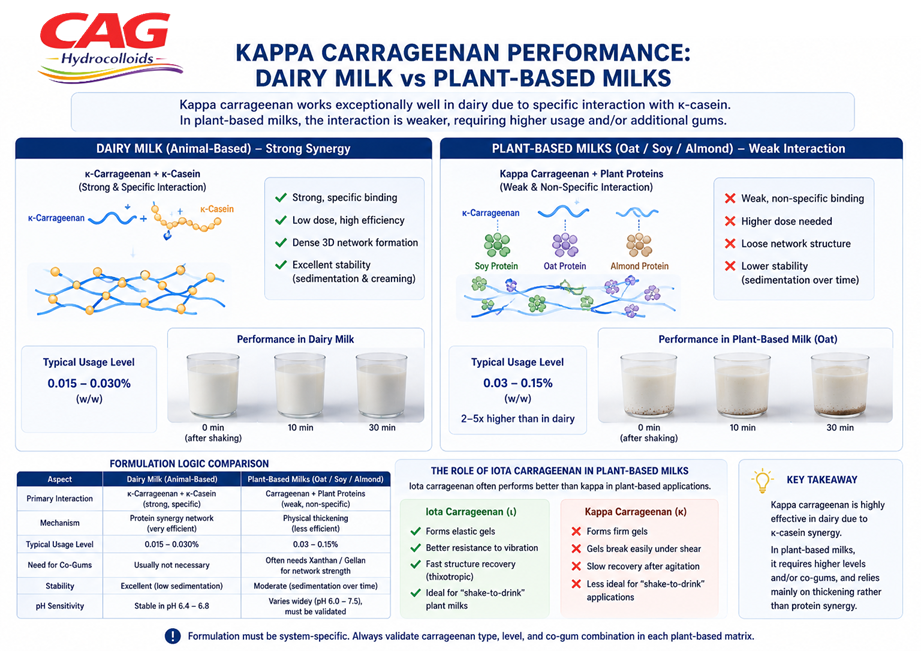 fig. Carrageenan performance varies in dairy and plant based milk
In soy milk, electrostatic interactions between carrageenan and soy proteins do occur. However, both the selectivity and strength of these interactions are significantly weaker than those observed in κ-casein systems.
To achieve effective stabilization, carrageenan usage levels typically need to be increased to 0.03–0.10%, approximately 2–5 times higher than those used in dairy applications. In addition, formulators often incorporate complementary hydrocolloids such as xanthan gum or gellan gum to compensate for the weaker network structure.
Oat milk and almond milk generally contain lower protein levels and exhibit even weaker protein–carrageenan interactions. In these systems, carrageenan functions primarily as a thickening and suspension agent, rather than as a component of a protein-synergy network.
pH management is also considerably more important in plant-based beverages. Different plant proteins exhibit different buffering capacities and operate within varying pH ranges (typically pH 6.0–7.5). Therefore, carrageenan dissolution behavior, hydration characteristics, and long-term stability must be validated individually for each formulation.
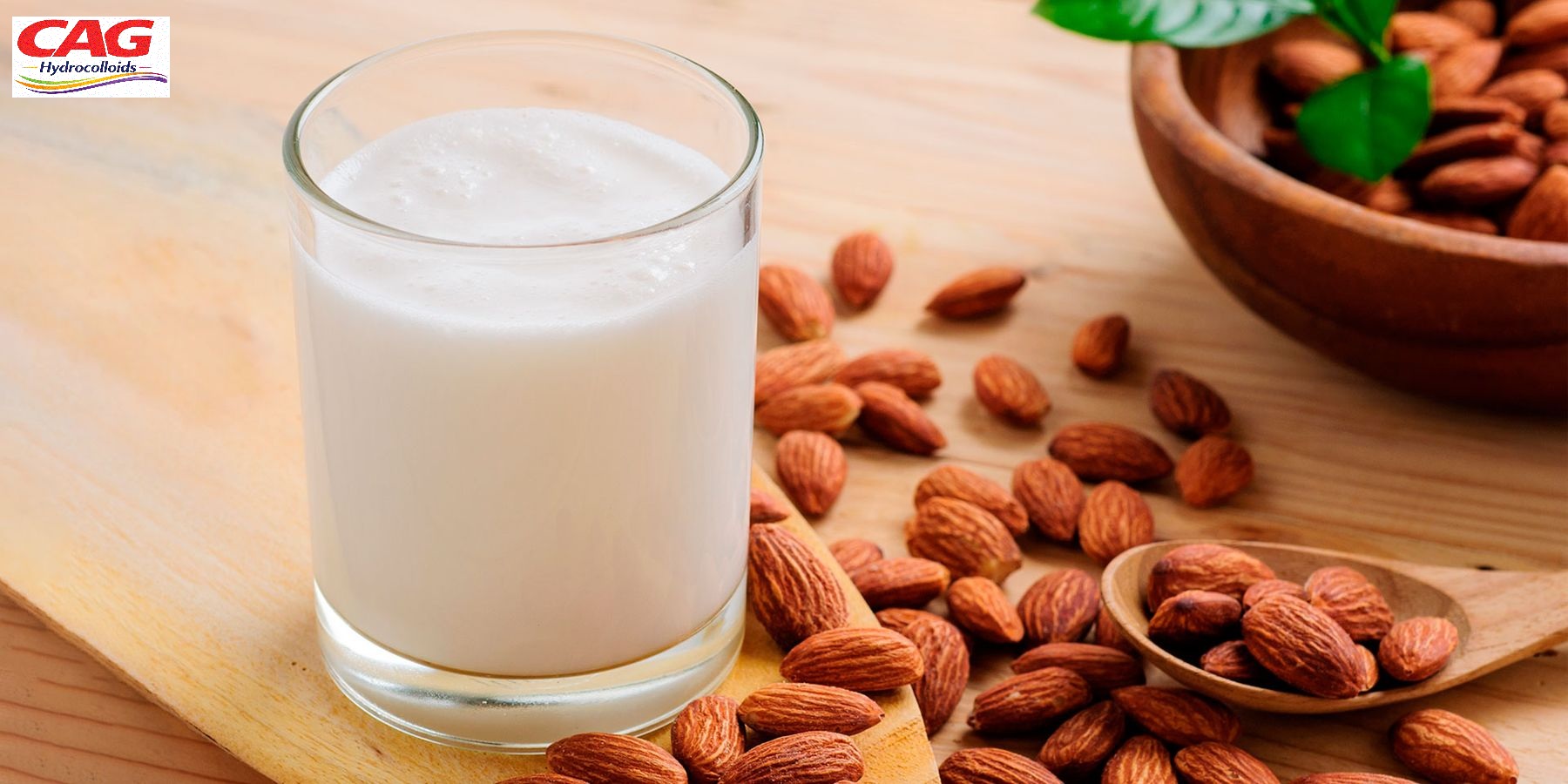
In certain plant-based beverages, ι-carrageenan may provide better performance than κ-carrageenan.
The elastic gel network formed by ι-carrageenan can maintain particle suspension even after moderate vibration or handling during transportation and storage. In contrast, once a κ-carrageenan gel network is disrupted by shear, its structural recovery is generally slower.
For ready-to-drink plant-based beverages that are expected to be shaken or stirred before consumption, the thixotropic recovery properties of ι-carrageenan or κ2-rich carrageenan systems can become an important selection criterion.
Carrageenan does not perform in plant-based milks in the same way it does in dairy milk.
The success of κ-carrageenan in dairy products is largely driven by its highly specific interaction with κ-casein. In plant-based systems, this mechanism is either greatly weakened or absent altogether.
As a result:
For formulators, the transition from dairy to plant-based beverages is not simply a matter of increasing carrageenan dosage—it requires a fundamentally different stabilization strategy built around the unique characteristics of each plant protein system.


Email: info@cagcolloids.com
Tel: 0086-19884908291 / 0086-573- 80890620
Website: www.cagcolloids.com
Address: No. 399, East Tongfu Road, Tongxiang City, Zhejiang Province. China.