


FAQs
Nature Refined, Quality Defined
Green Science for better living

Black Spots in Hydrocolloids Powder: Causes, Inspection, and Acceptance Criteria
Black spots refer to visible dark or black impurity particles in white or light-colored hydrophilic colloid powder. They primarily originate from two categories:
Process-related black spots (endogenous)
Caused by localized overheating or scorching during production.
Common stages: drying (e.g., wall scorching in spray dryers), grinding (friction-induced carbonization), or extrusion.
Foreign black spots (exogenous)
Result from wear and tear of equipment or packaging materials.
Common sources: worn plastic/rubber seals, blade fragments, packaging debris, or environmental contaminants.
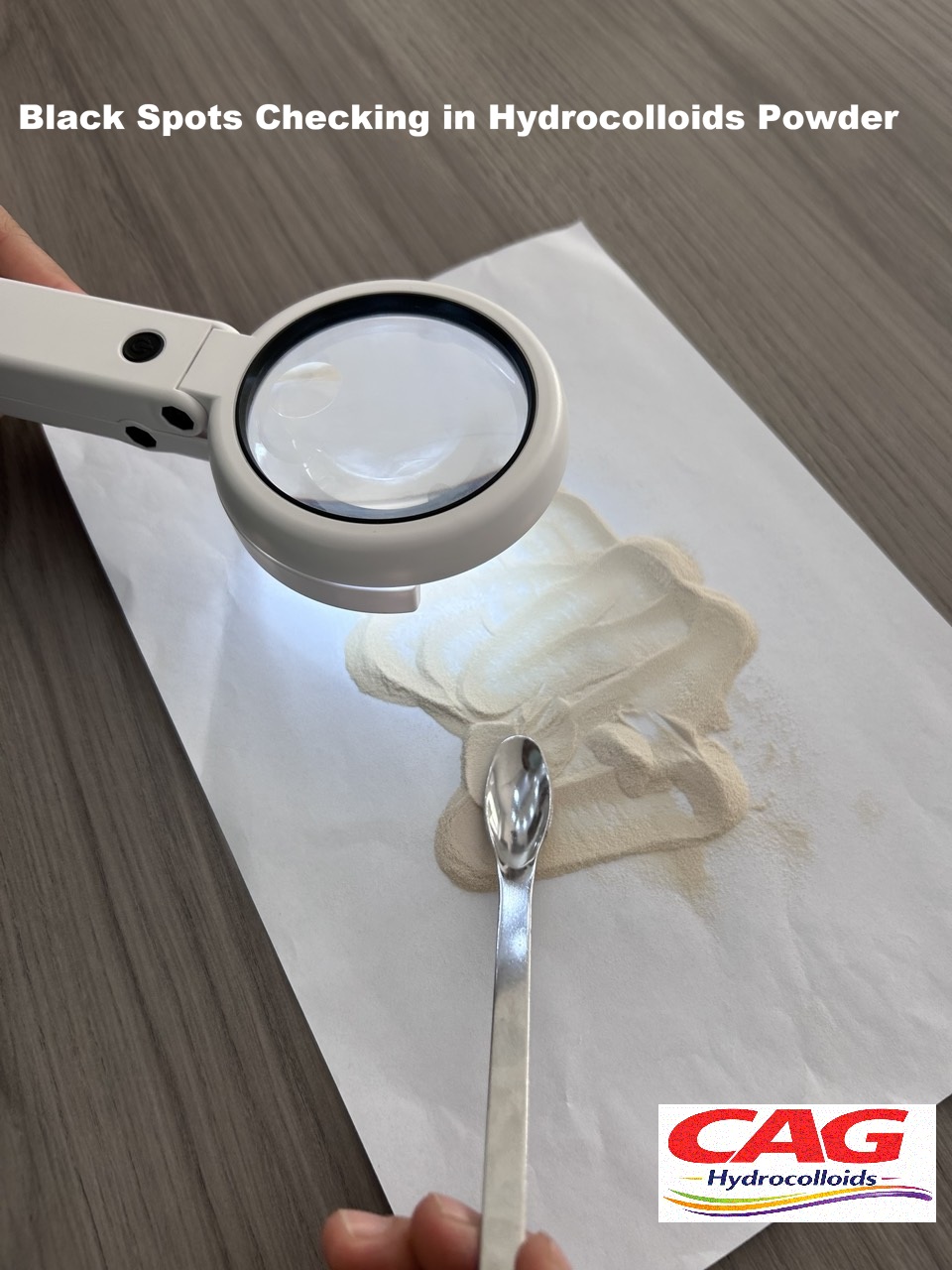
Method: White paper spreading with backlight visual inspection.
Equipment: Analytical balance (0.01g accuracy), A5 white paper, glass plate, LED inspection light, magnifier (5–10×), tweezers, petri dish.
Procedure:
Weigh 10.00g of sample.
Spread evenly on A5 paper (layer thickness ~1–2 mm).
Place under uniform backlight and scan systematically with a magnifier.
Pick out and count all visually distinct dark spots.
Acceptance limit: Typically ≤5–10 black spots per 10g sample (subject to customer specifications).
Quick screening (solubility test):
Place individual black spots in hot water (>80°C).
Completely soluble → Likely scorched colloid (process-related).
Insoluble → Likely foreign material (e.g., plastic, metal).
Definitive analysis:
Techniques like FTIR or microscopy can identify materials (e.g., plastic, rubber, carbonized organics).
Acceptable:
Process-related spots within quantity limit (e.g., ≤10/10g).
Reject:
Black spots exceed limit, or
Any confirmed non-colloid foreign material (plastic, metal, etc.).
Preventive measures for suppliers:
Optimize drying/grinding to avoid overheating.
Replace wear-prone parts with food-grade alternatives.
Implement sieving, metal detection, or X-ray inspection


Email: info@cagcolloids.com
Tel: 0086-19884908291 / 0086-573- 80890620
Website: www.cagcolloids.com
Address: No. 399, East Tongfu Road, Tongxiang City, Zhejiang Province. China.