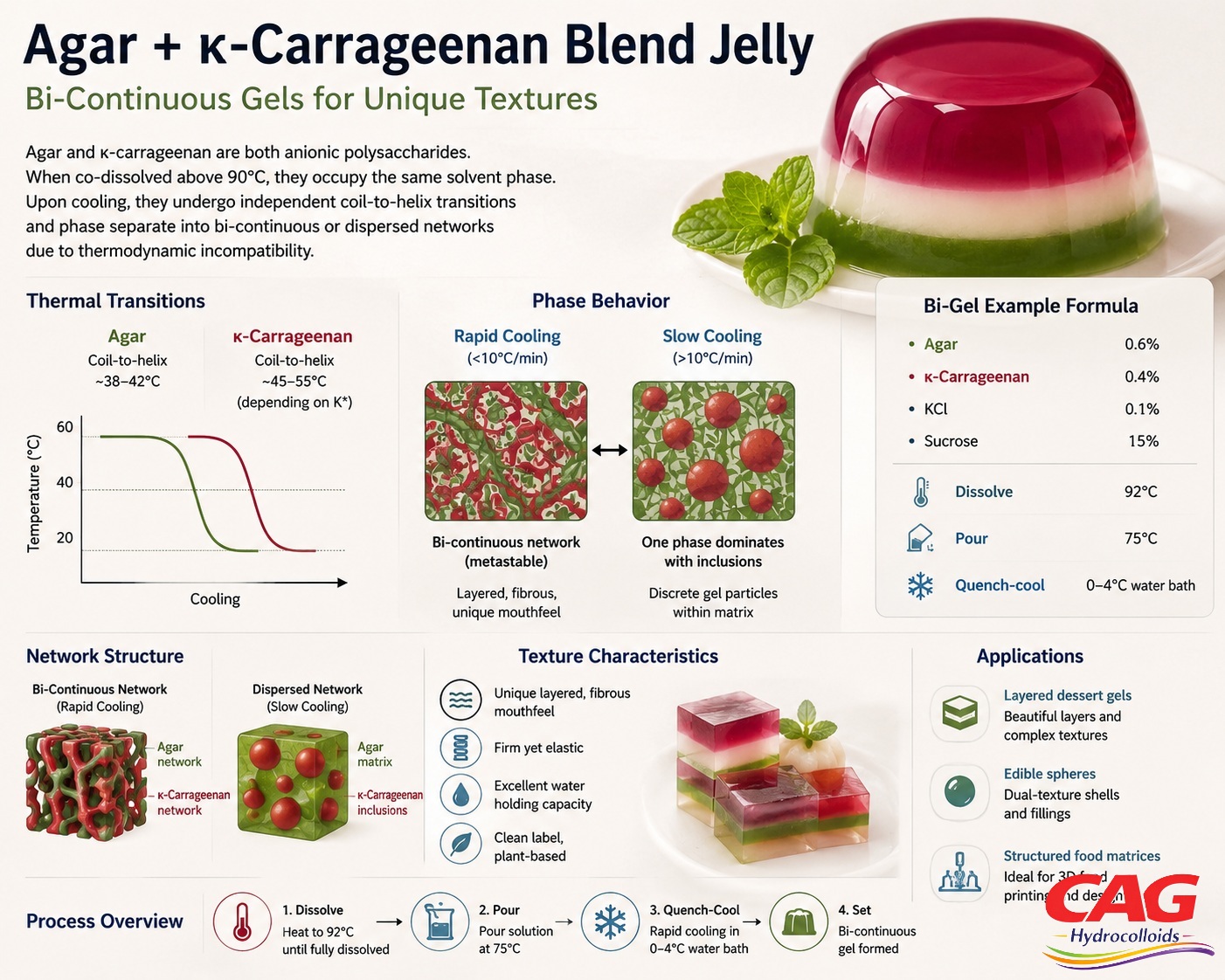
Thermodynamic incompatibility: Agar and κ-carrageenan are both anionic polysaccharides; when co-dissolved above 90°C they occupy the same solvent phase. Upon cooling, both undergo independent coil-to-helix transitions (agar: ~38–42°C; κ-carrageenan: ~45–55°C depending on K⁺), and because they are thermodynamically incompatible at high concentrations, they undergo phase separation into a bi-continuous or dispersed network.
Engineering bi-continuous textures: At near-equal concentrations (0.5–0.8% each), cooling rate determines which phase becomes continuous. Rapid quench (<10°C/min) traps a metastable bi-continuous network giving a unique layered, fibrous mouthfeel used in Japanese traditional anmitsu and modern food art. Slow cooling allows one phase to dominate, producing inclusions of one gel within the other.
✦ Bi-gel example: Agar 0.6% + κ-Carrageenan 0.4% + KCl 0.1% + Sucrose 15%, dissolved 92°C, poured at 75°C, quench-cooled in 0–4°C water bath
Applications include layered dessert gels, edible spheres with dual-texture shells, and structured food matrices for 3D food printing.