Acid Degradation of Gellan Gum: Mechanisms, Quantification, and Process Safety Margins
A technical guide to understanding irreversible changes in Low Acyl (LA) Gellan Gum under high-temperature acidic conditions and how to design safe food processes.
Degradation Mechanisms and Stability Thresholds
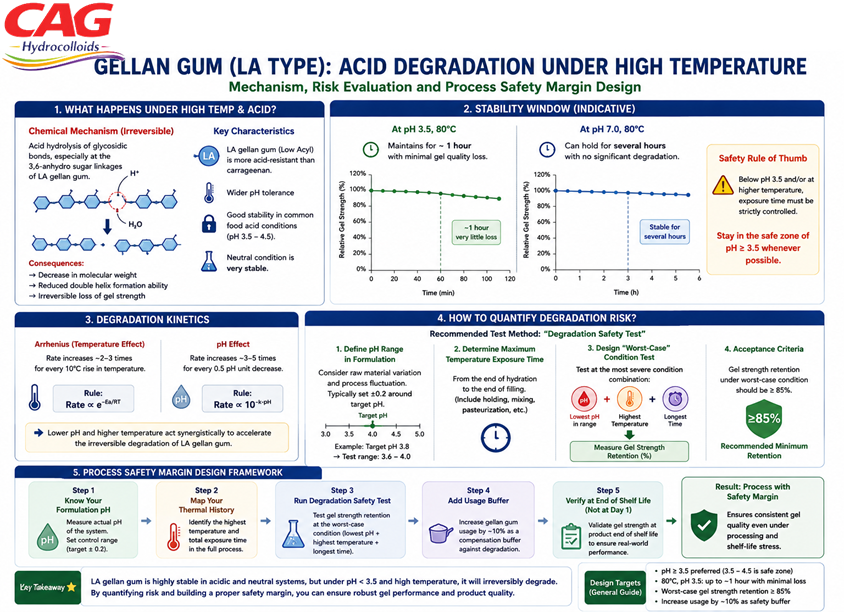
The acid degradation mechanism of LA Gellan Gum is similar to that of carrageenan, though it tolerates a broader pH range. The text specifies the following stability thresholds:
-
Stable Conditions: At pH 3.5 and 80°C, LA Gellan maintains gel quality with minimal loss for approximately 1 hour. Under neutral conditions (pH 7), it can withstand several hours at 80°C without significant degradation.
-
Risk Zone: Gellan exhibits good stability within the common food acid range (pH 3.5–4.5). However, exposure time must be strictly controlled when pH drops below 3.5 and temperatures are high.
Chemical Kinetics of Degradation
The chemical essence of degradation is the hydrolysis of glycosidic bonds (specifically at the 3,6-anhydroglucosyl sites). This leads to a reduction in molecular weight and a decreased ability to form double helices, resulting in an irreversible weakening of gel strength.
The rate of acid degradation follows the Arrhenius relationship:
-
Temperature: Reaction rate increases by a factor of 2–3 times for every 10°C rise.
-
pH: Reaction rate increases by a factor of 3–5 times for every 0.5 unit decrease.
Designing a Process Safety Margin
To mitigate risk, establish a safety margin using the following framework:
-
Define pH Variability: Determine the actual pH distribution range of the formula, accounting for raw material batch variations and process fluctuations (typically ±0.2 around the target pH).
-
Map Time-Temperature Exposure: Calculate the total duration of high-temperature exposure from the completion of gum hydration to the end of filling.
-
Conduct Worst-Case Testing: Design a "Degradation Safety Test" combining the worst conditions (lowest pH + highest temperature + longest time). The requirement is that gel strength retention must be ≥85% under these worst-case conditions.
-
Implement Buffering: Increase the gellan dosage by 10% as a degradation compensation buffer. Always validate gel strength at the end of the product's shelf life, not just at the beginning.
Keywords: Gellan Gum Degradation, Acid Hydrolysis, Food Process Design, Shelf Life Stability, LA Gellan, Arrhenius Kinetics.