


FAQs
Nature Refined, Quality Defined
Green Science for better living

Why is low-acyl gellan gum highly sensitive to divalent cations Ca2+, Mg2+ during the gelation process?
The gelation mechanism of low-acyl gellan gum involves the formation of double helices followed by the aggregation of these helices into a continuous three-dimensional network. Un-acetylated glucuronic acid residues on the gellan polymer chain carry negative carboxyl groups (-COO-). Divalent cations like calcium (Ca2+) and magnesium (Mg2+ act as direct ion bridges that electrostatically link carboxyl groups on adjacent double helices. This ion-bridging effect triggers rapid matrix compilation at much lower ionic concentrations compared to monovalent ions like sodium (Na+), heavily influencing the final gel strength and thermal stability.
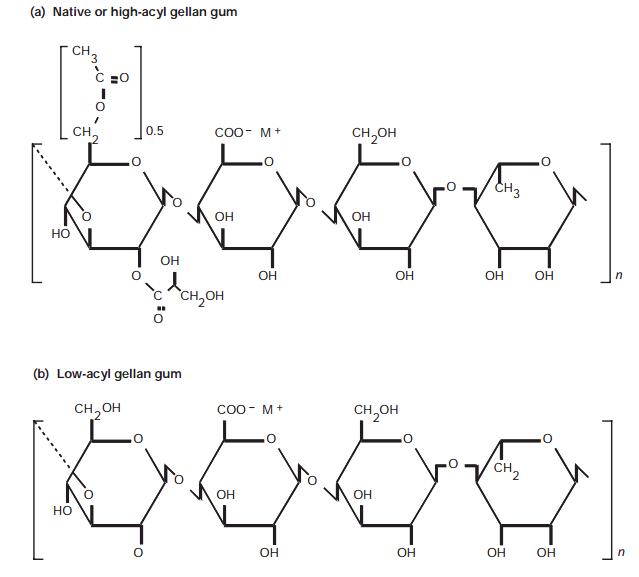
the structure of high and low acyl gellan gum
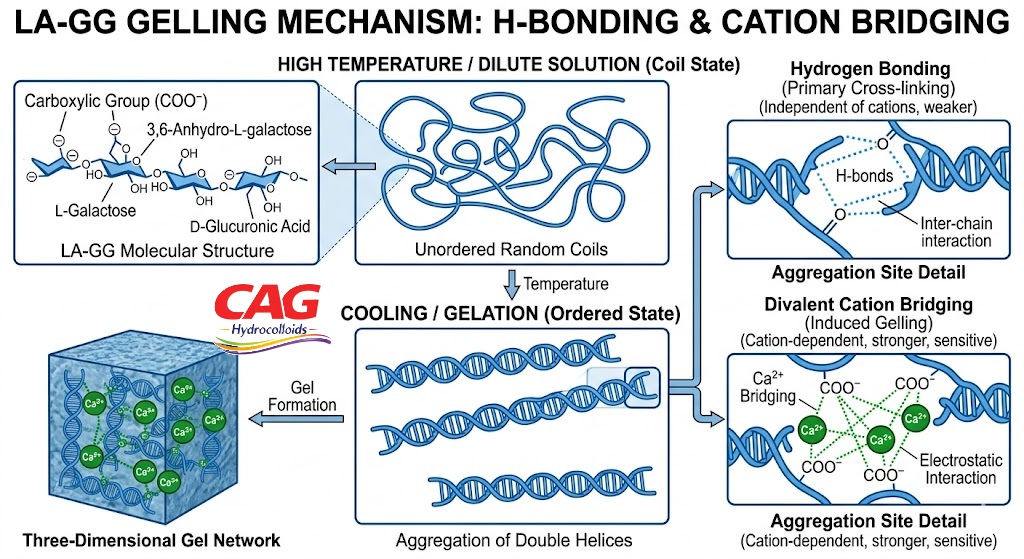
Dissolution gelation mechanism of low acyl gellan gum, gel induced by ions especially divalent ions


Email: info@cagcolloids.com
Tel: 0086-19884908291 / 0086-573- 80890620
Website: www.cagcolloids.com
Address: No. 399, East Tongfu Road, Tongxiang City, Zhejiang Province. China.