


FAQs
Nature Refined, Quality Defined
Green Science for better living

What are the critical factors affecting the solubility, dispersion, and stability of carrageenan in solution?
Successful application hinges on understanding these factors:
Solubility Drivers: The type of carrageenan and the associated cations are paramount. Lambda and sodium salts of kappa/iota dissolve in cold water. However, potassium or calcium salts of kappa/iota are insoluble in cold water and must be dissolved with heat (above 60°C/140°F). High concentrations of other solutes (salts, sugars) can compete for water and inhibit dissolution.
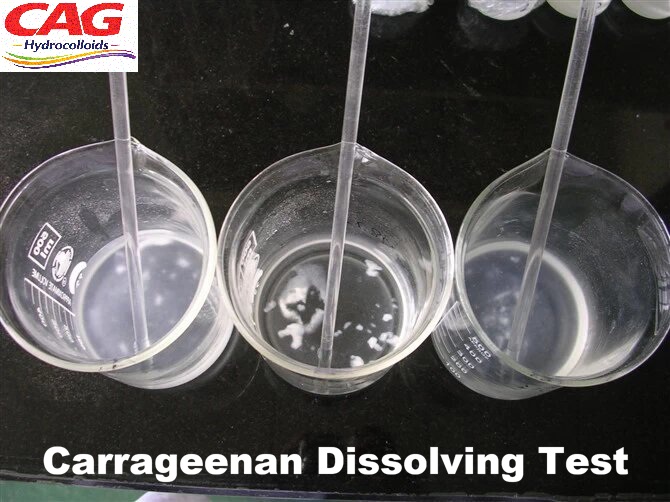
Dispersion Challenge: Carrageenan powder hydrates rapidly on the surface, forming lumps that are difficult to dissolve. Techniques to prevent this include: 1) Pre-blending the powder with other dry ingredients like sugar (at a 1:10 ratio), or 2) Using a high-speed mixer to achieve vigorous agitation during addition to the liquid.
Stability in Solution: Carrageenan is stable at neutral and alkaline pH. It is susceptible to acid hydrolysis when heated in solution at pH levels below 3.5, leading to a breakdown of glycosidic bonds and loss of gel strength. Therefore, in acidic products, it is best to add acid late in the process after the carrageenan is dissolved and cooled. Once gelled, the structure is more resistant to acid degradation.


Email: info@cagcolloids.com
Tel: 0086-19884908291 / 0086-573- 80890620
Website: www.cagcolloids.com
Address: No. 399, East Tongfu Road, Tongxiang City, Zhejiang Province. China.